By Maryna Poplavska, Head of Project Managers · 22 October 2026
A twenty-minute one-to-one video call on LiveKit Cloud costs five or six cents — our arithmetic on the published overage rates, at 1.0 Mbps and before any plan allowance. That is the honest headline, and nearly useless on its own, because it moves with one number: how much video the call carries. Halve that and the same call costs under four cents; at the 1.5 Mbps LiveKit’s own sample code captures, six or seven.
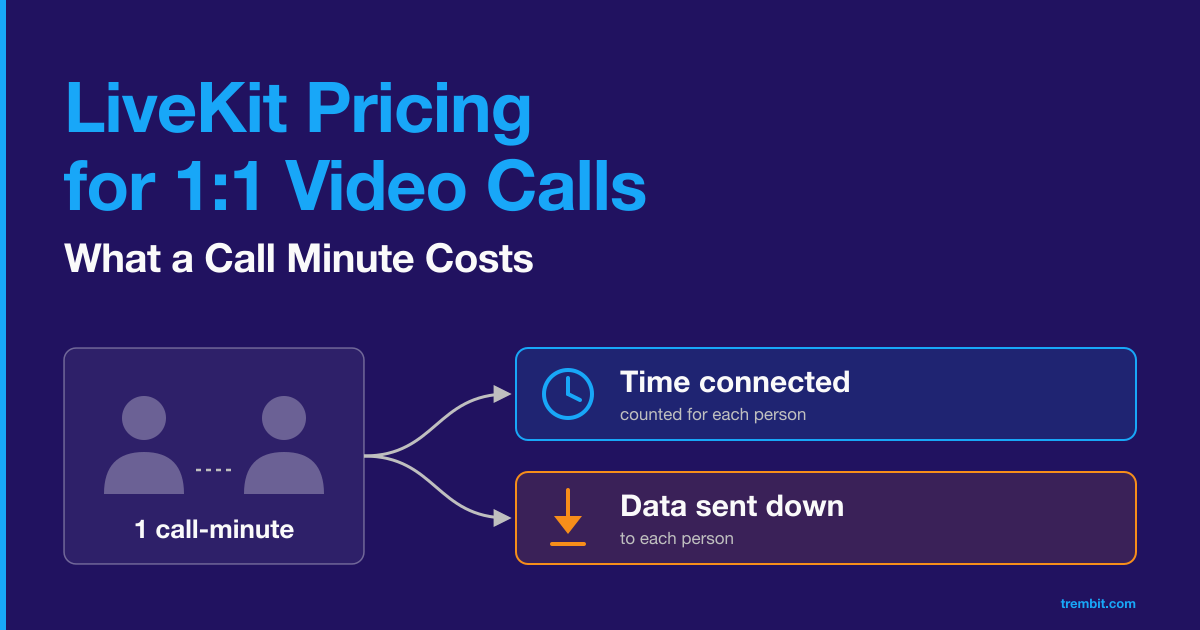
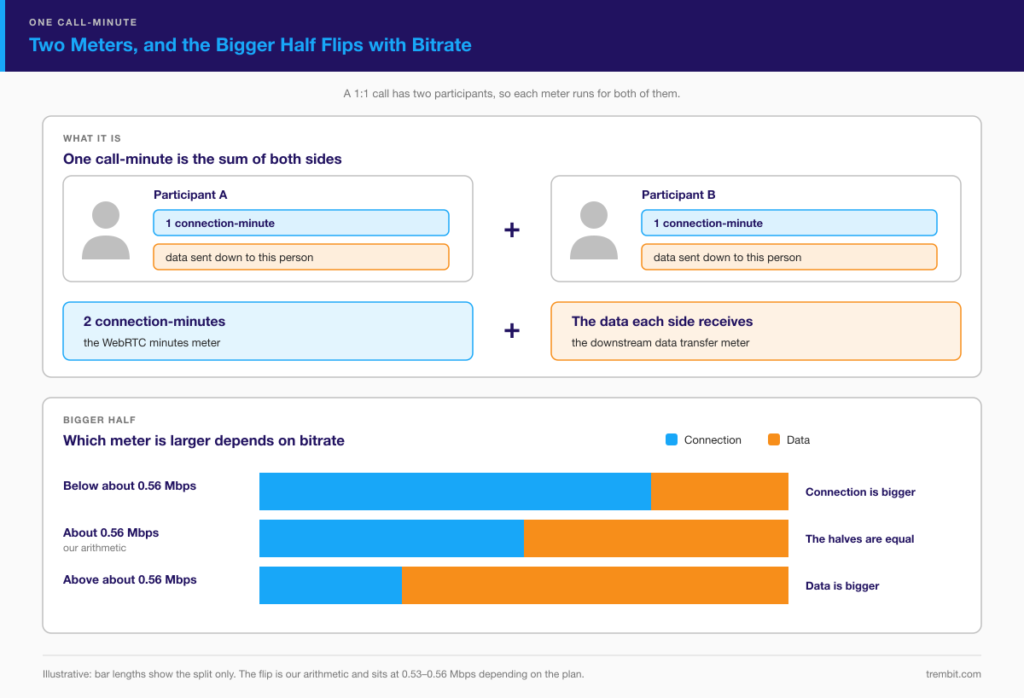
LiveKit bills a call on two meters — the time each person is connected (WebRTC minutes) and the data sent down to them (downstream data transfer). A one-to-one call has two people, so one call-minute is two connection-minutes plus whatever each side receives. Carry little video and the connection fee is the bigger half; carry a lot and the data takes over (ours). That is why a per-minute figure means little without a bitrate attached.
We have built 1:1 video platforms on managed WebRTC clouds, but we have no bill to show you. What follows is the published meter and arithmetic you can re-run.
Prices re-checked against LiveKit’s pricing page on 29 October 2026. Neither that page nor the billing docs carries a revision date, and the per-GB rate has moved before — $0.18 to $0.12, in the same 2024 change that introduced the connection fee. Recompute with the page open.
Key takeaways
- A twenty-minute call costs five or six cents at 1.0 Mbps — under four at half that bitrate, six or seven at 1.5 (our arithmetic, before plan allowances).
- The concurrency cap is a limit of its own, separate from the bill. LiveKit caps how many people can be connected at once — 100, 1,000 or 5,000 by plan, which works out at 50, 500 and 2,500 two-person calls (our arithmetic).
- The two meters are the connection and the data: $0.0005 a participant-minute on Ship and $0.0004 on Scale, plus $0.12 and $0.10 a gigabyte down. Past about 0.56 Mbps the data is the bigger half on either plan (our arithmetic).
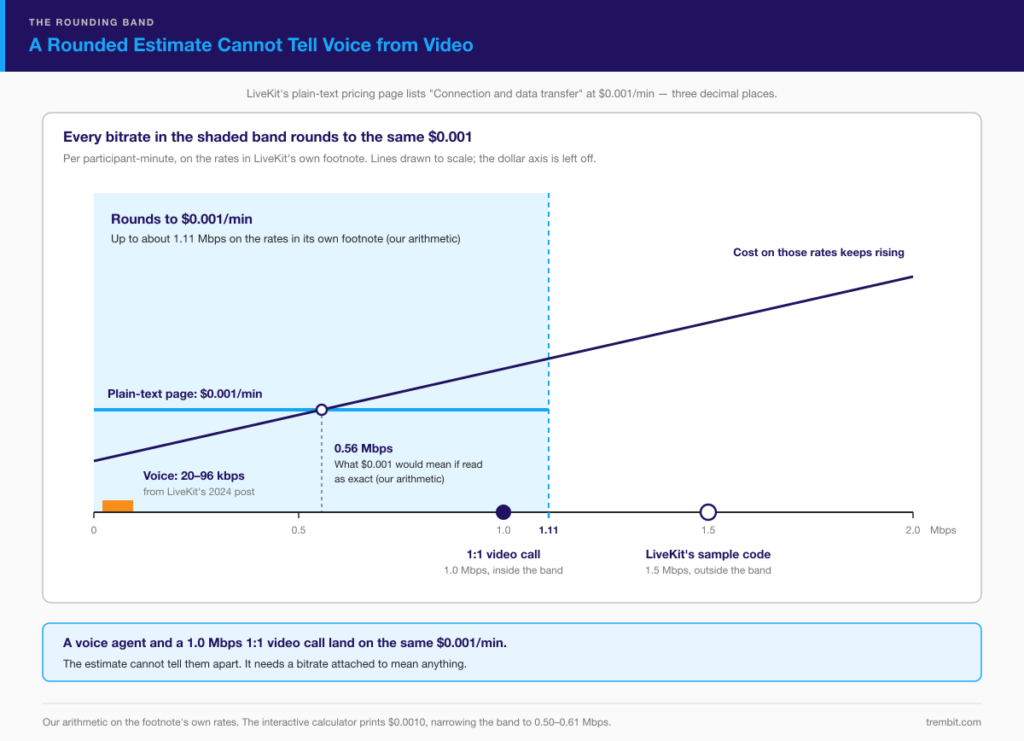
- LiveKit’s own estimate is “$0.001/min” on the plain-text pricing page, $0.0010 in the interactive calculator. Neither prices a 1:1 video call — on the rates in its own footnote the first covers everything from voice to about 1.11 Mbps, the second pins 0.50–0.61 Mbps — and on those rates a participant-minute at 1.0–1.5 Mbps runs 40–85% above it (our arithmetic).
- The caps count connections, not calls. A third joiner in a room is a third connection (ours); where managed recording sits in that count we could not confirm.
What did we run, and what can this article not tell you?
The platform we built ran on a managed WebRTC cloud, unchanged through the project. We are not naming it. Self-hosting was written up and never executed — a plan on paper, by the delivery team’s own account.
Which meter dominated, and whether anything was switched off to save money, our code cannot say — that lives in a billing console we do not have. We would rather leave that blank than guess.
Where on LiveKit’s pricing page does a plain video call’s cost live?
WebRTC minutes sits under Participants and downstream data transfer under Media transport. LiveKit’s quotas page defines them as “Time that a single user is connected to LiveKit Cloud via a LiveKit SDK” and “The total data transferred out of LiveKit Cloud during a session, including media tracks and data packets.”
Most of the rest prices agents, recording, stream import and telephony — none of which a plain two-person call pays; see the cost of running a voice AI platform.
What does one minute of a 1:1 call cost on LiveKit Cloud?
Each person pays to be connected and pays for what they receive: connection rate + (bitrate in Mbps × 0.0075 GB × per-GB rate) per participant-minute. The 0.0075 is unit conversion: 1 Mbps for sixty seconds is 7.5 MB, or 0.0075 GB if a gigabyte means a billion bytes. Counting 1,024-based instead bills about 7% fewer gigabytes, which is roughly 4–5% off the total (ours); the billing docs do not say which LiveKit uses.
| Downstream bitrate | Ship $/participant-min | Scale $/participant-min | Ship $/call-min | Scale $/call-min |
|---|---|---|---|---|
| 1.0 Mbps | $0.0014 | $0.00115 | $0.0028 | $0.0023 |
| 1.5 Mbps | $0.00185 | $0.001525 | $0.0037 | $0.00305 |
Ours. Inputs: overage rates only, one downstream stream per participant, decimal GB; Ship $0.0005/min + $0.12/GB, Scale $0.0004/min + $0.10/GB. A 20-minute call at 1.0 Mbps is 40 participant-minutes: $0.056 on Ship, $0.046 on Scale.
So which bitrate is yours? LiveKit’s track-configuration docs show sample code capturing 1280×720 at maxBitrate: 1_500_000, alongside two smaller copies of the same video at 500 and 150 kbps. The page labels that snippet “Room defaults” and says its presets carry recommended bitrates — a documented starting point, not a measurement of what any deployment sends. And the server gives each viewer one copy, not all three, so what someone receives can sit below the biggest. That last step is ours, and it is why the table is a range rather than a price.
What LiveKit’s own per-minute estimate does and does not tell you. The plain-text pricing page carries a row reading “Connection and data transfer | $0.001/min”, footnoted “Estimate combining a connection rate of $0.0005/min and a data transfer rate of $0.12/GB.” The interactive calculator prints the same number to four places, $0.0010 (choose Web/mobile). Neither is a video price, and how it is rounded decides how far off it is: at three places anything from voice up to about 1.11 Mbps displays as $0.001, while at four places it pins 0.50–0.61 Mbps, about half a video stream. Carry either into a video budget and a participant-minute at 1.0–1.5 Mbps is 40–85% above it on those rates. Ours.
What would a month of 1:1 calls cost on each plan?
Hypothetical, not our client’s: 500,000 WebRTC minutes a month (12,500 twenty-minute calls), allowances applied.
| Plan (our arithmetic) | 1.0 Mbps (3,750 GB) | 1.5 Mbps (5,625 GB) |
|---|---|---|
| Ship — $50/mo, 150,000 min + 250 GB included | $645 | $870 |
| Scale — $500/mo, 1.5M min + 3 TB included | $575 | $762.50 |
Ship at 1.0 Mbps: $50 + 350,000 overage minutes at $0.0005 ($175) + 3,500 GB at $0.12 ($420). Scale pays no minute overage (500,000 is inside its 1.5M allowance) and 750 GB at $0.10. Both plan fees are worded “starting at”, so treat them as floors.
Above roughly 0.7 Mbps at this volume the $500 plan is cheaper than the $50 one — at 0.5 Mbps Ship still wins, $420 against $500 (ours). At this volume, allowances and plan floors decide more than per-unit rates do (ours).
One reconciliation, since we have published a higher number: our cost breakdown across architectures puts LiveKit Cloud at about $800 and up for the same 500,000 minutes. That $800 sits inside this table’s $575-to-$870 span. Its own assumptions include 25% relay traffic, which this table does not price, so a bitrate solved back out of it — about 1.6 Mbps on Scale — is an upper bound, not a like-for-like reading (ours).
Running this on a real product? Talk to our team.
How many 1:1 calls can one LiveKit Cloud project hold at once?
The published caps are 100 / 1,000 / 5,000 connections on Build, Ship and Scale. At two people a call that is 50 / 500 / 2,500 calls at once (ours). We read that row and the quotas page’s as one limit (ours); it counts the “Total number of connected agents and end-users across all rooms” — so if something server-side joins every room, three connections a call drops you to 33 / 333 / 1,666 (ours). Where managed recording sits in that count we could not confirm.
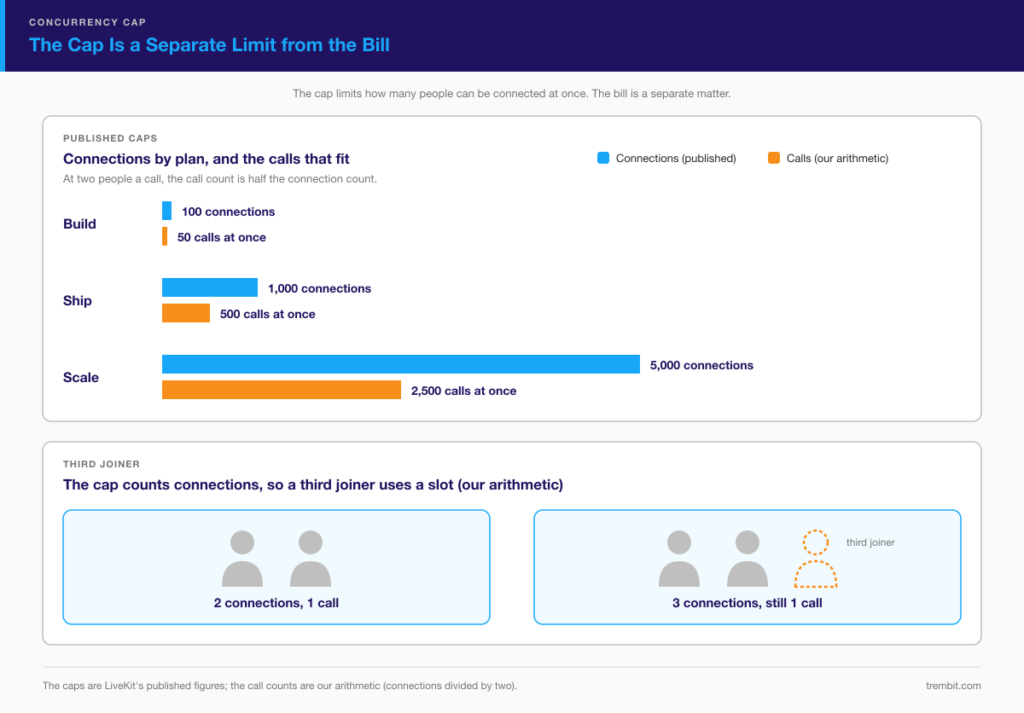
Plan for a given number of simultaneous calls and you are planning for twice that many connections (ours), so the published Scale cap of 5,000 is reached at 2,500 calls. Past that the published tiers stop and you are into an Enterprise quote.
What does LiveKit not charge for, and where does it round?
Upstream data is not metered: the billed row is downstream, and LiveKit’s August 2024 pricing post said “We will no longer meter data sent from your application to LiveKit servers.”
The billing docs meter time in seconds with “a 10-second minimum per session” — a short call is not rounded up to a whole minute. They list no relay line, and we could not verify how relayed TURN traffic is metered; ask LiveKit.
When does self-hosting LiveKit start to beat LiveKit Cloud for 1:1 video?
For 1:1 calls, minutes alone cannot settle it (ours) — and the prior question is whether a two-person call needs a media server at all. Our comparison of media server architectures puts it plainly: “P2P has essentially no media-server compute cost (you run signaling and TURN, not media routing)”, though it will not scale far.
Self-hosting removes the plan fee and the per-minute connection fee, and reprices the bytes at your own egress rate instead of LiveKit’s $0.10–$0.12 (ours, from the published rates). The connection fee is no rounding error: 26–36% of the per-minute cost on both paid plans at 1.0–1.5 Mbps (ours). The bill to beat is modest: a million WebRTC minutes on Scale is $950 at 1.0 Mbps and $1,325 at 1.5, plan fee included (ours). Your cluster has to land under that including egress, servers and on-call.
So three things decide it for 1:1 video, not one: the gigabyte price you can buy, your peak concurrency (which sizes the cluster) and your minute volume (which drives both halves of the bill). That refines, for 1:1 calls, our general baseline of 500K–1M participant-minutes a month: on LiveKit Cloud’s rates, that range is where pricing your own cluster starts; the other two settle it (ours).
Which makes it a ladder: stay put, go up a plan when the allowances say so, ask for an Enterprise quote, price your own cluster last. If the server choice is open, see LiveKit versus mediasoup; a WebRTC architecture review prices both routes on your traffic.
Work it through with your own numbers
Bring four numbers to a free 30-minute call — bitrate, average call length, peak concurrency, current plan — and an engineer who builds this topology will work it through.
FAQ
How much does LiveKit cost per minute for video calls? Most of it depends on your bitrate. At 1.0 Mbps a call-minute is $0.0028 on Ship and $0.0023 on Scale, or about five or six cents for a twenty-minute call (our arithmetic on overage rates, before allowances).
Is LiveKit Cloud free? Build is $0 a month: 5,000 WebRTC minutes, 50 GB of downstream data, 100 concurrent connections. Which runs out first depends on bitrate — at 1.0 Mbps the 50 GB stretches to about 6,667 participant-minutes, so the minutes go first (ours). The two meet at about 1.33 Mbps (ours), above which data goes first. Paid plans start at $50 and $500.
How many 1:1 calls can LiveKit Cloud run at the same time? 50 on Build, 500 on Ship, 2,500 on Scale (ours), from the published 100 / 1,000 / 5,000 caps at two participants a call. An extra participant is another connection, so plan for fewer.
When is it cheaper to self-host LiveKit? In our reading it turns on your gigabyte price, your peak concurrency and your minute volume together, not any one of them. A million connected minutes on Scale is roughly $950–$1,325 a month at 1.0–1.5 Mbps (ours), and your cluster must come under that including bandwidth, servers and on-call.