Telehealth has become a cornerstone of modern healthcare, but many platforms still rely on legacy monoliths or fragile WebRTC setups. In 2026, these outdated architectures struggle to meet the demands of scalability, security, and seamless integration. Modernizing to cloud-native architectures isn’t just a technical upgrade — it’s a strategic move to deliver better patient experiences, reduce costs, and unlock agility. As patient expectations rise and digital healthcare expands, the pressure to modernize has never been greater. Trembit is ready to guide telehealth providers through this critical transformation.
Legacy Challenges Exposed

Many telehealth platforms are built on monolithic systems that are costly and difficult to maintain. On average, legacy platforms require approximately $40,000 per year in maintenance and consume 17 hours of IT staff time weekly.
Additionally, weak WebRTC implementations often result in latency issues, particularly in low-bandwidth areas.
Integration gaps with electronic health records (EHRs) prevent real-time data sharing, creating operational inefficiencies and frustrating clinicians and patients alike.
And when it comes to security, the stakes are even higher — healthcare breaches now average $9 million per incident, as legacy code often lacks modern security patches.
These challenges make it clear: relying on outdated architecture in 2026 not only limits growth but also jeopardizes patient trust and organizational reputation. It’s no longer enough to patch old systems; modernization is essential.
Why Cloud-Native Architecture Changes the Game
The limitations of legacy systems naturally lead to the question: how can telehealth platforms evolve? The answer lies in cloud-native architectures, powered by microservices, Kubernetes, and serverless computing.
By moving to cloud-native designs, platforms can:
- Scale seamlessly: Auto-scaling resources handle surges in consultation demand without downtime.
- Optimize costs: Pay-as-you-go models on AWS, Azure, or Google Cloud can reduce infrastructure costs by 30–50%.
- Enhance video quality: Cloud-managed WebRTC signaling servers enable adaptive streaming, ensuring smooth video even in remote areas.
- Increase agility: Microservices allow rapid deployment of new features, including AI diagnostics and predictive analytics.
- In short, cloud-native is not only about technology, but it’s also about transforming the way healthcare is delivered.
Modernization Roadmap
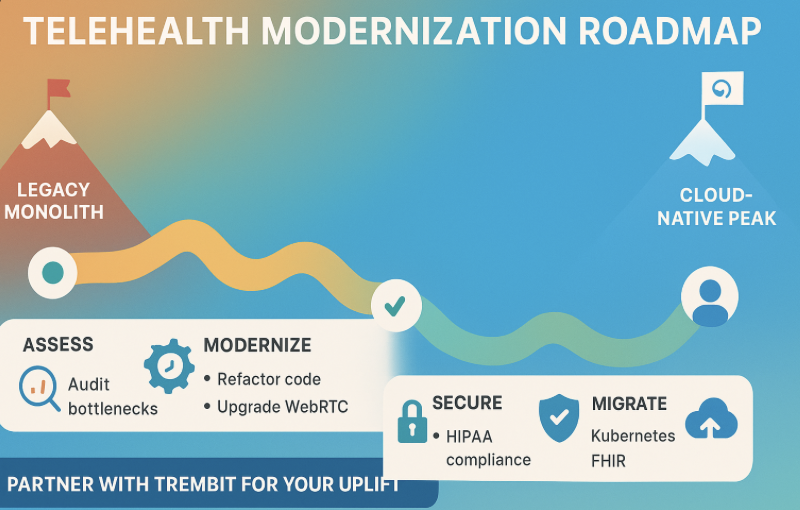
Transitioning from legacy to cloud-native may seem daunting, but a structured roadmap can simplify the process. Here’s how to approach it step by step:
- Assess Current State: Audit your monolith to identify bottlenecks. Map EHR integrations using FHIR APIs.
- Adopt Microservices: Break your system into independent services (consultations, monitoring, payments) orchestrated by Kubernetes.
- Strengthen WebRTC: Move to cloud-managed signaling servers to achieve low-latency, HIPAA-compliant video.
- Ensure Compliance: Implement zero-trust security and AI-driven monitoring from day one.
- Test and Deploy: Use CI/CD pipelines for rapid iterations, and apply A/B testing to optimize user adoption.
Following this roadmap ensures a smooth transition, allowing organizations to reap the benefits of cloud-native architecture without disrupting existing services.
Key Architecture Comparison
To understand the impact of modernization, compare legacy and cloud-native approaches:
| Aspect | Legacy Monolith / WebRTC | Cloud-Native Modernized |
| Scalability | Manual provisioning, downtime-prone | Auto-scaling, handles 10x surges |
| Security | Patch gaps, high breach risk | Zero-trust, real-time encryption |
| Integration | Rigid APIs, EHR silos | FHIR/microservices, seamless data flow |
| Cost | $40K+/system maintenance | 30–50% savings via serverless |
| Innovation Speed | Slow updates, no AI-ready | Rapid AI/telemetry additions |
The comparison is clear: cloud-native modernization accelerates innovation, reduces costs, and strengthens security—critical factors for thriving in the competitive telehealth market.
Trembit’s Proven Uplift Expertise
Modernizing telehealth platforms is complex, which is why Trembit offers expert guidance. Our architects specialize in delivering FHIR-compliant, cloud-native platforms with robust WebRTC for clients worldwide. Recent projects have reduced deployment times by 40% while boosting uptime to 99.99%.
Whether it’s an MVP uplift or a full platform migration, Trembit provides tailored roadmaps to ensure HIPAA/FHIR readiness. With our guidance, telehealth providers can confidently navigate the modernization journey and achieve measurable improvements.
Future-Proof Features for 2026
To stay ahead in the rapidly evolving telehealth space, consider incorporating these cutting-edge features:
- AI diagnostics and predictive analytics for personalized care.
- Multi-language support and accessibility for diverse patient populations.
- Edge computing for ultra-low latency remote monitoring.
- Blockchain for secure data sharing across ecosystems.
By integrating these capabilities, telehealth providers modernize and future-proof their platforms, ready to meet rising patient demand and leverage new technologies for superior care.
Modernizing your telehealth platform today positions your organization for growth, efficiency, and innovation in 2026. With Trembit’s expertise, legacy challenges transform into opportunities, delivering secure, scalable, and patient-centric care at the forefront of digital healthcare.