In an age where digital viewers expect flawless video experiences—regardless of their device or connection—adaptive streaming has become the backbone of high-performance video delivery. At Trembit, we engineer media streaming solutions that scale smoothly and adapt intelligently. Today, we’re diving into how AI enhances adaptive streaming to provide consistent quality, real-time optimization, and next-level viewer satisfaction.
What is Adaptive Streaming?
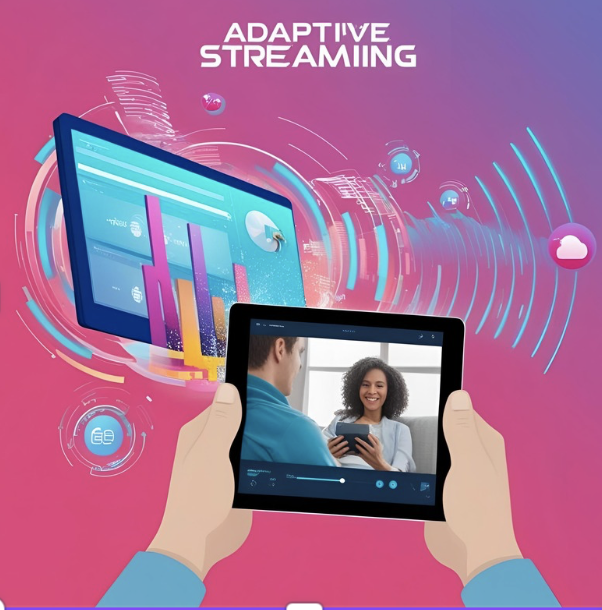
Adaptive streaming dynamically adjusts video quality based on a user’s current bandwidth, device capabilities, and network conditions. Rather than sending a single static video file, the content is encoded into multiple quality levels and divided into small chunks. As playback progresses, the video player requests the optimal chunk quality based on real-time conditions.
HTTP Live Streaming (HLS) and Dynamic Adaptive Streaming over HTTP (MPEG-DASH) protocols are the most common foundations of adaptive streaming.
The Traditional Approach: Rules-Based Adaptation
Before the rise of AI, adaptive streaming relied heavily on a deterministic set of rules to manage video playback quality. These rules were hardcoded into the video player and designed to make real-time decisions based on a narrow set of metrics—typically, the available bandwidth and buffer status.

How It Works
In a rules-based system, the video player performs regular checks on:
- Current download throughput (measured over the last few seconds)
- Playback buffer levels
- CPU or device load (in some advanced implementations)
Based on this data, the video chunk with the most suitable bitrate from a predefined set is chosen. If the connection slows down, it drops to a lower quality. If it speeds up and the buffer is stable, it switches up.
This approach usually follows a fixed logic like:
If bandwidth < 1 Mbps:
Select 480p
Else if bandwidth < 2.5 Mbps:
Select 720p
Else:
Select 1080p
Common Pitfalls of the Rules-Based Method
While functional and widely used, rules-based adaptive streaming systems have several limitations:
1. Over-sensitivity to Short-Term Fluctuations
Network conditions, especially on mobile and Wi-Fi connections, often fluctuate rapidly. Rules-based players may interpret a temporary dip as a sustained issue and downgrade the quality too aggressively, leading to poor visual experience and excessive bitrate switching.
2. Lack of Contextual Awareness
The system has no awareness of historical user behavior, time-of-day traffic patterns, or device-specific performance. It treats each playback session independently and reacts only to present-moment conditions.
3. Inefficient Use of Buffer
Traditional logic often makes overly conservative decisions about when to switch up quality, even when there’s sufficient buffer capacity. This can result in prolonged low-quality viewing even when the user’s network could support higher resolutions.
4. No Learning or Adaptation Over Time
Rules-based systems do not evolve. The logic remains static regardless of how often a user has watched a video or how a specific network performs in different conditions. There is no mechanism to improve the decision-making process based on past outcomes.
Why it’s still relevant
Despite these drawbacks, rules-based adaptation remains common due to its simplicity, predictability, and low computational overhead. It works reasonably well in stable network environments, especially with aggressive buffering strategies. Moreover, it is easier to implement and test, making it a default choice for many developers getting started with video streaming.
However, as user expectations grow and streaming environments become more fragmented (across devices, geographies, and networks), this approach struggles to consistently deliver high-quality experiences—especially in edge cases like congested mobile networks or high-latency rural connections.
This is precisely where AI-enhanced adaptive streaming takes over, offering a smarter, more responsive way to manage video quality.
Enter AI: Smart Adaptation in Real Time
AI-driven adaptive streaming replaces rigid rules with machine learning algorithms that continuously learn from network patterns, user behavior, and contextual factors. Here’s how AI improves the streaming experience:

1. Predictive Bandwidth Estimation
Instead of reacting to momentary dips in bandwidth, AI models predict future throughput based on trends. This proactive approach reduces the number of quality switches and buffering incidents.
Trembit integrates real-time data modeling into client-side logic using lightweight ML models optimized for mobile and web players.
2. Personalized Streaming Profiles
AI can adapt streaming strategies to individual users. For example, a user consistently watching 1080p videos on a high-speed network might receive higher-bitrate content sooner, while another on mobile data gets a more conservative profile.
This personalization increases satisfaction and optimizes bandwidth usage—especially useful in OTT or video-on-demand (VOD) platforms.
3. Content-Aware Encoding
AI helps identify less complex scenes (e.g., talking heads in a Zoom-like conference) and allocates fewer bits to these segments, preserving quality while saving bandwidth. Trembit’s encoding pipeline can integrate AI-based perceptual quality models (like Netflix’s VMAF) to fine-tune compression.
4. QoE Optimization
AI continuously tracks metrics like buffering ratio, playback startup time, and bitrate switching frequency to optimize the Quality of Experience (QoE) in real time. Models then adjust decision policies across millions of sessions.
Challenges and the Road Ahead
While AI adds intelligence, it also adds complexity:
- Model accuracy varies by region, device, and content type
- Client-side computing and power constraints limit the model size
- Privacy concerns require thoughtful telemetry handling
Yet, with the rise of edge computing and federated learning, Trembit is pioneering next-gen adaptive streaming engines that learn locally and scale globally—without sacrificing privacy.
Conclusion: From Reactive to Proactive
The shift from reactive, rule-based adaptation to proactive, AI-enhanced streaming is redefining video delivery. At Trembit, we’re all about making streaming smarter and smoother for everyone. If you’re building a video product and want it to keep up with users and tech trends, let’s chat. We implement streaming solutions that don’t just play—they adjust, improve, and grow with you.