In Germany, a practice can bill a video consultation to statutory insurance only if it uses a video service on the official KBV list of certified providers (Anlage 31b BMV-Ä). People often call these services “KBV-certified”. Strictly, KBV says they are certified by independent certification bodies under KBV and GKV-Spitzenverband rules. This guide covers 20 companies that build or run telehealth in Germany. For each one we say what is actually verified: a place on the KBV list (checked against the list dated 24 August 2026), a DiGA listing at BfArM, or delivery evidence on the company’s own site.
Germany’s digital healthcare ecosystem is rapidly evolving, driven by DiGA legislation, rising demand for remote care, and billions in funding from the Hospital Future Act (KHZG). For providers looking to scale compliant telemedicine platforms or integrate with the Telematikinfrastruktur (TI), choosing the right tech partner is critical.
Some entries are development partners; others are platforms or DiGA makers you would partner with or integrate. The table says which is which. Trembit publishes this guide and is listed first; our entry sticks to what we can show.
Our Research Approach
We looked for companies that build or run telehealth software for the German market: development partners, platform providers, device makers and DiGA makers. Not every company meets every criterion below; the table says what evidence we found for each, with an eye to regulatory fit and long-term viability in the healthcare sector.
To curate this list, we looked for companies that show at least one of the following:
- A track record of building DiGA-compliant or TI-integrated telehealth platforms
- Alignment with EU MDR, GDPR or ISO 27001 requirements
- Secure patient data management, interoperability or teleconsultation features
- Real-world case studies, partnerships, or deployments with German clinics, hospitals, or insurers
We checked every company in September 2026 against three public sources: the KBV list of certified video-service providers (Stand 24.08.2026), the BfArM DiGA directory, and each company’s own website. Where we couldn’t verify a claim, we left it out.
Top 20 Telehealth Developers and Platforms for Germany (2026)
| Rank | Company | Focus Area | Verified status | Notable Projects/Clients |
| 1 | Trembit | Development partner: WebRTC video for telehealth and teletherapy | Built webPRAX Face2Face, on the KBV list (valid to 02/2028); DSGVO; HIPAA projects | webPRAX Face2Face (psychotherapy), HIPAA video translation platform |
| 2 | CompuGroup Medical | Practice software, TI, video (ELVI, CLICKDOC) | KBV list (8+ services) | 8,700+ staff, 60 countries |
| 3 | ZTM Bad Kissingen | Telemedicine products and research | Publicly funded research arm (ZTM e.V.) | NIDAklinik, Copilot, Curafida |
| 4 | MedKitDoc + Bright Inventions | Device-supported telemedicine for care homes | Certified video (KBV list, via XPERTyme); CE devices | TK, AOK Nordost, BARMER projects |
| 5 | TeleClinic | Online doctor consultations, eRezept | KBV list (TÜV IT); TÜV Saarland data protection | 6M+ treatments; part of DocMorris |
| 6 | Zava | Online diagnosis & prescriptions | KBV list (Zava Sprechstunde Online GmbH) | 15M+ treatments across Europe |
| 7 | Ada Health | AI symptom assessment | EU MDR Class IIa | NHS, Kaiser Permanente, Sutter Health |
| 8 | Doctolib | Scheduling + video | KBV list (TÜV NORD) | 42,000+ doctors use its video (DE + FR) |
| 9 | Wellster Healthtech | Operates digital-clinic brands | GDPR | GoSpring, easy-testen, mySummer |
| 10 | Edvantis | Frontend + UI for telehealth UX | GDPR, ISO | Wellster |
| 11 | sprylab | Health apps and portals, DiGA feasibility | Regulated-software experience | Insurers, hospitals, pharma |
| 12 | Apzumi | Medtech software + device integration | Works to ISO 13485 / IEC 62304 | RPM, rehab, diabetes |
| 13 | MASIMO Germany | Remote monitoring hardware | CE, FDA | Hospitals, home care |
| 14 | Tunstall GmbH | Emergency call + telecare | DIN EN ISO 9001:2015 | Care homes, assisted living, hospitals |
| 15 | Inworks | Hospital quality & risk management software | ISO 9001 + ISO 27001 | German hospitals and care homes |
| 16 | Vivira Health Lab | Back-pain therapy app | DiGA (permanently listed) | Prescribable, statutory cover |
| 17 | HelloBetter | Online therapy programmes | 6 DiGA (permanently listed) | 140,000 participants |
| 18 | arztkonsultation ak GmbH | White-label / API video consultation | 21 services on the KBV list | KV video services, clinics |
| 19 | jameda (Patientus) | White-label video for hospitals | 13 services on the KBV list | UKSH, Helios, Uniklinikum Jena instances |
| 20 | XPERTyme GmbH | White-label video platform | 8 services on the KBV list (up to 50 participants) | MedKitDoc, enna, medityme |
Detailed Platform Reviews
1. Trembit
Trembit is a WebRTC development company (Trembit LLP, UK; engineering in Kyiv; presence in London and Valencia). For Healthy Projects GmbH we built webPRAX Face2Face, a psychotherapy video platform that sits on the KBV list of certified video-service providers (certificate valid to February 2028, up to 20 participants). The architecture was shaped by Anlage 31b: peer-to-peer WebRTC with self-hosted STUN/TURN, Germany-only hosting, end-to-end encryption and DSGVO compliance, reviewed by the Institut für Sicherheit und Datenschutz im Gesundheitswesen.
We work as the engineering team behind telehealth products: video consultation, group therapy sessions, in-call tools, and HIPAA-compliant real-time AI translation built on a Mediasoup SFU.
Key Features:
- Video consultation built to the Anlage 31b requirements (P2P, self-hosted TURN, E2E encryption, German hosting)
- Group sessions, waiting room, encrypted chat, whiteboard, EMDR tools (webPRAX)
- WebRTC media servers (P2P, SFU) and rescue of unstable video codebases
- Real-time AI in the call: transcription and translation (HIPAA project)
- Support through the certification evidence a KBV-listed provider has to file
Use cases: psychotherapy and mental health platforms (webPRAX Face2Face), remote diagnostics (a HIPAA-compliant, FDA-registered uroflowmetry app), and in-call medical interpretation. See our telemedicine app development work.
2. CompuGroup Medical (CGM)
CompuGroup Medical is one of Germany’s largest health IT providers (8,700+ staff, active in 60 countries). Its video services, including CGM ELVI and CLICKDOC Videosprechstunde, are on the KBV list. Their telehealth solutions are tightly integrated with the national Telematikinfrastruktur (TI), enabling full support for electronic prescriptions (eRezept), sick notes (eAU), and insurance billing. CGM’s software powers everything from online consultations to complex EHR systems.
Key Features:
- Fully TI-compliant teleconsultation and eRezept workflows
- Integrated practice management (PVS) and scheduling tools
- Video consultation services on the KBV list (certified to September 2027)
- Support for digital sick notes (eAU), referrals, and secure messaging
- Real-time interfaces with insurers and labs
3. ZTM Bad Kissingen
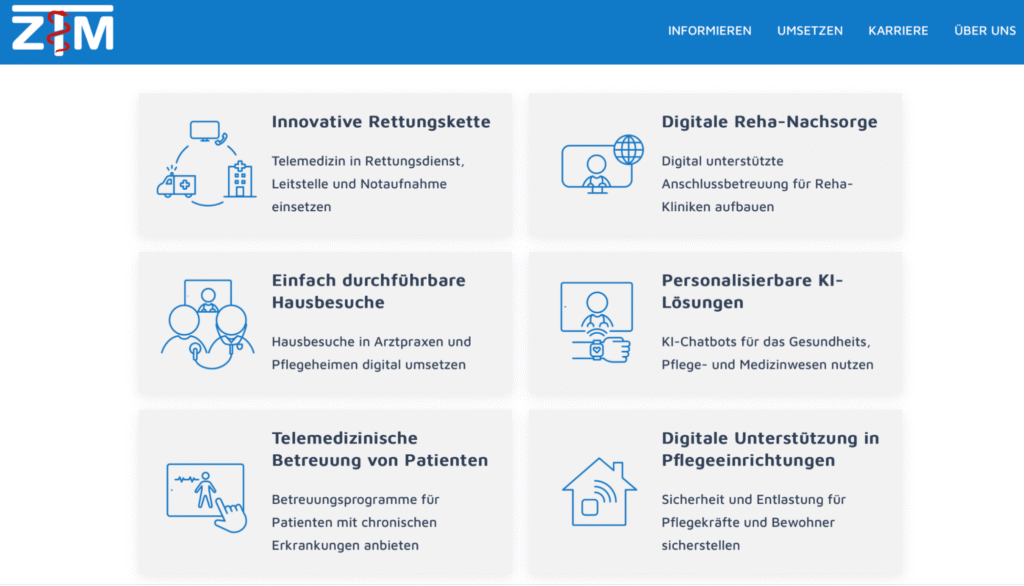
ZTM Bad Kissingen GmbH builds telemedicine products (NIDAklinik, Copilot, Curafida); its sister research association, ZTM e.V., is funded by the Bavarian health ministry. It partners with hospitals, payers, and municipalities on RPM and care coordination solutions, particularly for elderly and chronic patients. ZTM-developed platforms have been successfully used in several national pilots.
Key Features:
- Remote patient monitoring (RPM) for geriatrics and cardiology
- Telemedicine pilot projects and research partnerships
- Emergency alert and mobile triage systems
- Real-time dashboards for doctors and caregivers
- Integrations with EHRs and hospital networks
4. MedKitDoc (with Bright Inventions)
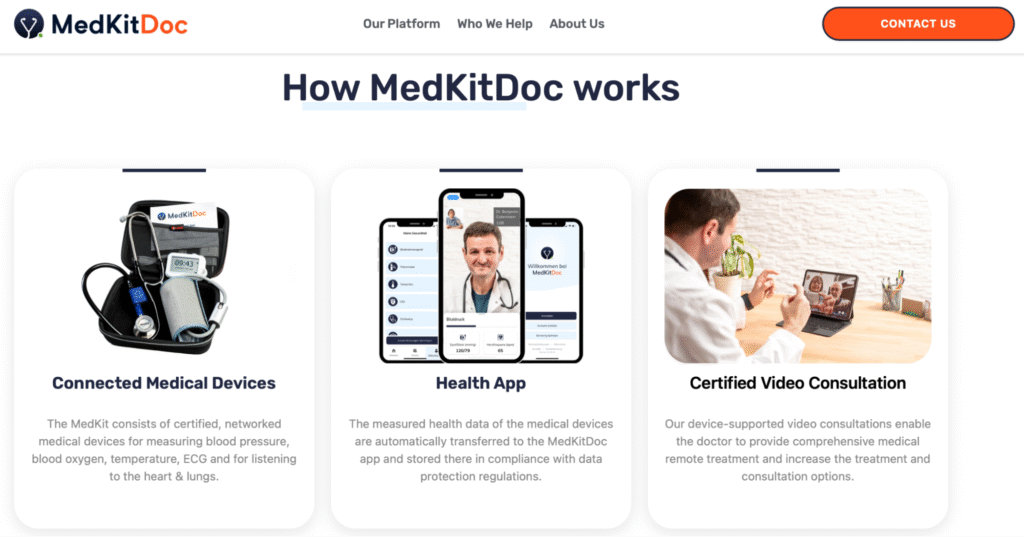
MedKitDoc bridges the gap between teleconsultation and real-time physical diagnostics. By pairing video consultations with CE-certified Bluetooth medical devices (e.g., stethoscopes, pulse oximeters), physicians can monitor patient vitals during the call. Their development partner Bright Inventions supports technical scaling and regulatory compliance.
Key Features:
- Live video consults with integrated diagnostic device data
- CE-certified hardware bundle (temperature, heart, lungs, etc.)
- Easy onboarding for caregivers in nursing homes
- GDPR-compliant cloud infrastructure
- Supports physician collaboration in rural or low-access areas
5. TeleClinic
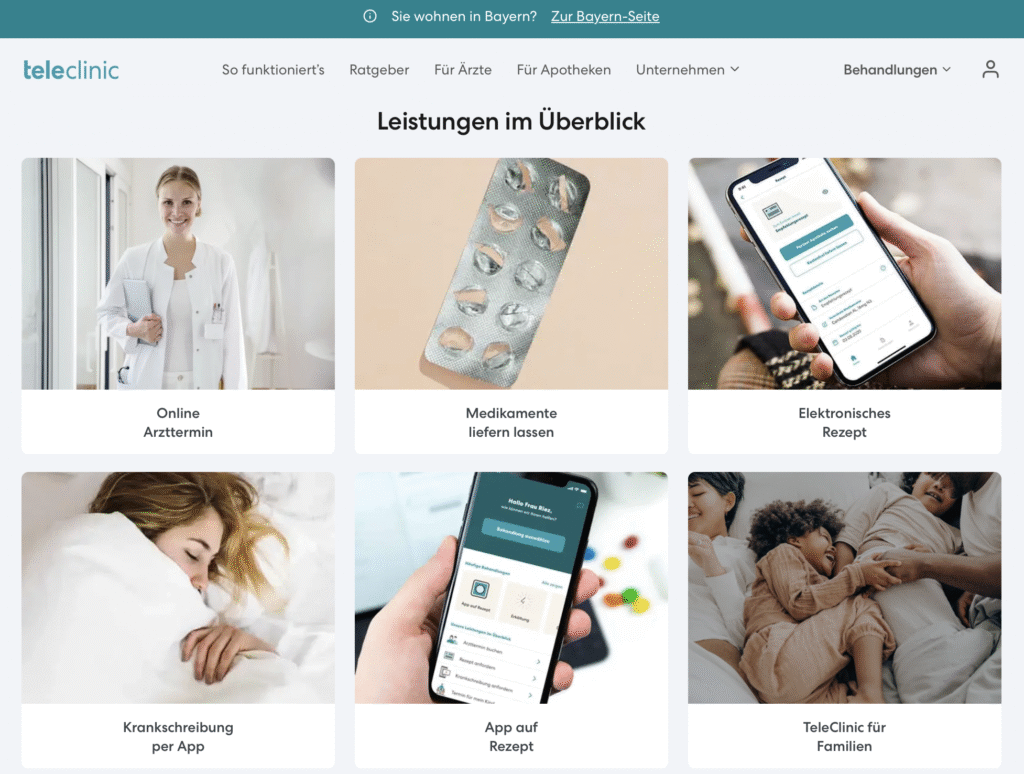
TeleClinic is a leading virtual care platform in Germany, offering 24/7 access to certified doctors via mobile and desktop. Acquired by DocMorris, TeleClinic powers digital care journeys from symptom check to ePrescription—all within a few clicks. Consultations are covered by statutory health insurance; the site reports 6M+ treatments and 7,000+ doctors.
Key Features:
- Video consultation service on the KBV list (certified by TÜV Informationstechnik)
- Built-in support for eRezept, eAU, and digital sick leave
- Doctor marketplace with integrated availability
- Data protection certified by TÜV Saarland
- Seamless integration with pharmacy delivery services
6. Zava
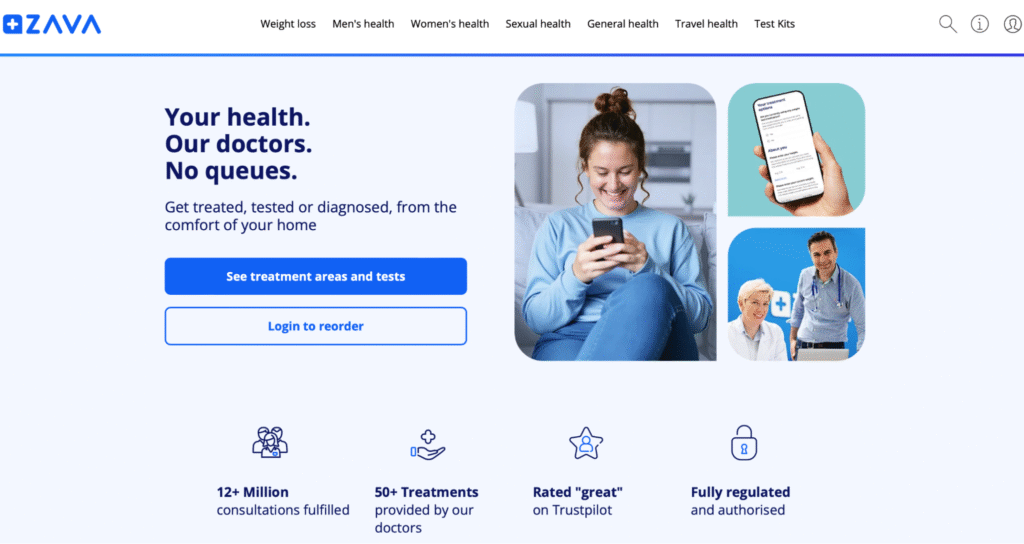
Zava reports 15M+ treatments across Europe, most of them questionnaire-based. It offers asynchronous consultations, lab testing, and prescription services with a strong focus on usability and medical compliance. Its video service (Zava Sprechstunde Online GmbH) is on the KBV list.
Key Features:
- Asynchronous and synchronous (live) consultations
- Quick access to prescriptions and follow-up support
- Treatment for common health concerns (e.g., dermatology, urology)
- Custom modules for insurers, employers, and pharmacy chains
7. Ada Health

Berlin-based Ada Health offers an AI-powered symptom checker and pre-diagnostics engine that supports both patients and doctors. While not a traditional teleconsultation provider, Ada’s technology is increasingly used to front-load telehealth triage and digital visits.
Key Features:
- CE-certified Class IIa AI for symptom assessment
- Natural language symptom intake for patients
- Integrations with digital clinics and insurer portals
- Multi-language support for global use
- Partners shown by Ada include the NHS, Kaiser Permanente and Sutter Health
8. Doctolib
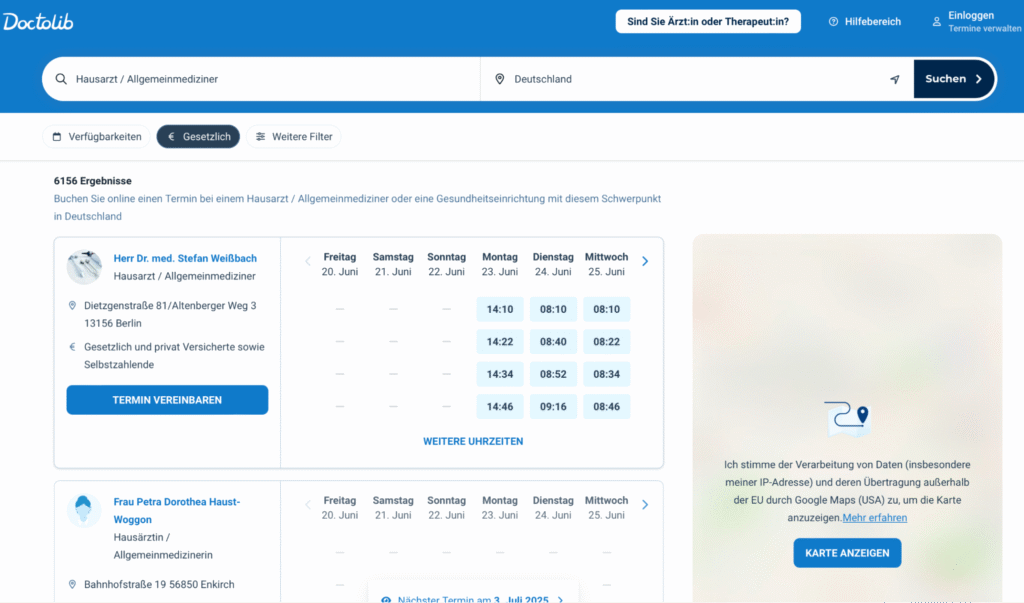
Doctolib is one of Europe’s largest medical appointment and video consultation platforms, widely adopted by German physicians and hospitals. Its video consultation service is on the KBV list (certified by TÜV NORD, up to 2 participants) and supports practice workflows, patient communication, and document exchange.
Key Features:
- Secure, certified video calls integrated with scheduling
- Document sharing, reminders, and e-prescription support
- 42,000+ doctors in Germany and France use Doctolib video; 40M+ video consultations to date
- CE-compliant, GDPR-first data handling
- Available on mobile and web with German hosting
9. Wellster Healthtech
Wellster builds and operates its own digital-clinic brands, such as GoSpring (men’s health) and easy-testen (STD testing). They combine eCommerce, asynchronous doctor reviews, and teleconsultation, with a focus on lifestyle health.
Key Features:
- Full-stack platform for patient onboarding, consults, and prescriptions
- Runs its own digital-clinic brands (GoSpring, easy-testen, mySummer, golighter)
- GDPR-compliant, German-based operations
- eCommerce + diagnostics integration
10. Edvantis
Edvantis is a software development firm with proven experience in telehealth UX/UI, backend systems, and mobile app development for German health tech companies such as Wellster (frontend and full-stack team of 1–6 engineers on React/TypeScript).
Key Features:
- Custom frontend and mobile development for telemedicine apps
- German healthcare compliance: GDPR, ISO
- API integration with pharmacy, lab, or insurance systems
- MVP design sprints and long-term support
11. sprylab

sprylab helps healthcare startups and pharma companies launch DiGA-compliant apps and platforms. Their expertise includes HL7/FHIR integration, MDR readiness, and rich front-end experiences for patient engagement.
Key Features:
- Expertise in CE/MDR-regulated software
- DiGA feasibility checks and development support
- Portals and apps for insurers, hospitals and pharma
- Fast prototyping + full backend infrastructure
- Strong visual design capabilities
12. Apzumi
Apzumi is a digital health and medtech development studio with deep experience in regulated software and CE-marked medical devices. Their work covers rehabilitation, diabetes monitoring, and RPM systems.
Key Features:
- Development to ISO 13485 and IEC 62304 practices
- Hardware integration: wearables, sensors, devices
- Remote rehabilitation and telemonitoring support
- DiGA-eligible architecture
- Full-service design and engineering
13. MASIMO Germany

MASIMO is a global leader in patient monitoring hardware. Their German division provides certified devices and software integrations for hospitals and remote care platforms.
Key Features:
- CE and FDA-cleared remote monitoring devices
- Cloud APIs for real-time vitals transmission
- Home care and remote patient monitoring (Masimo SafetyNet)
- Scalable deployment in hospitals and elder care
- Proven clinical-grade accuracy
14. Tunstall GmbH

Tunstall specializes in telecare, elderly care technology, and emergency response systems. Their platforms connect patients with caregivers via sensors, call buttons, and mobile devices, with deep integration into German care networks.
Key Features:
- Fall detection, remote call systems, and triage tools
- 24/7 telecare infrastructure for senior homes
- DIN EN ISO 9001:2015 certified (since 1997)
- Solutions for care homes, assisted living and hospital communication
- Home monitoring dashboards
15. Inworks GmbH
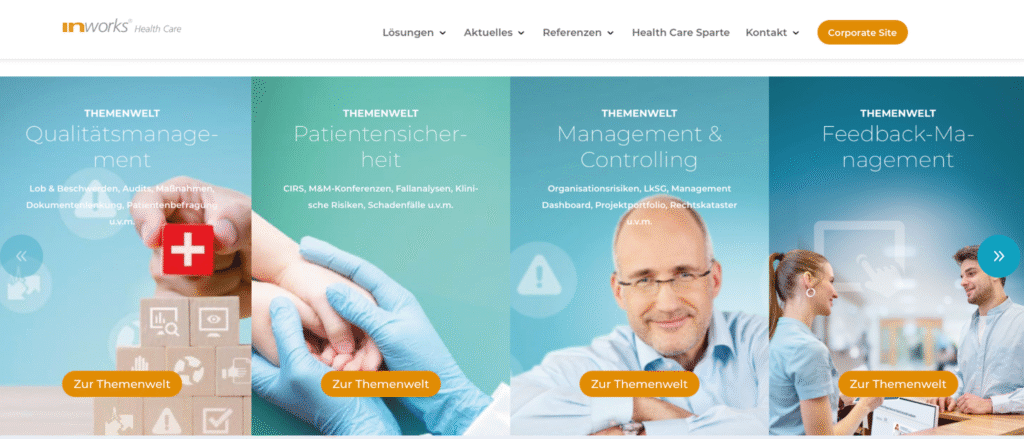
Inworks (Ulm) builds quality and risk management software for hospitals and care homes: QM, patient safety, complaint and audit management. It holds ISO 9001 and ISO 27001, and its servers are in Germany.
Key Features:
- Quality management, patient safety, complaint and audit management
- Hospital IT integration (HL7, IHE)
- GDPR and ISO 27001 hosting
- German-language support and rollout
16. Vivira Health Lab
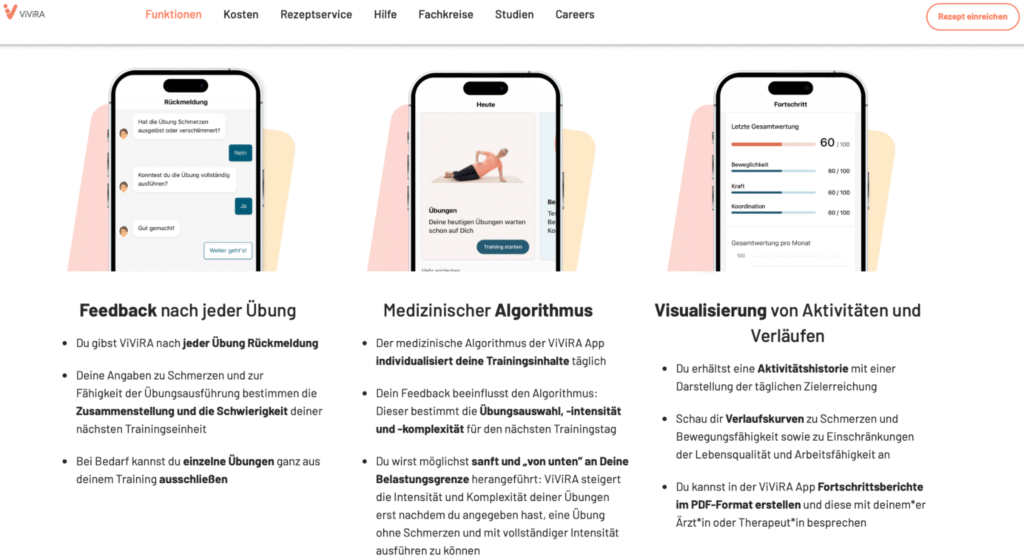
Vivira offers a DiGA-listed app for orthopedic telerehabilitation. Their platform supports digital physiotherapy and is reimbursed by statutory insurers in Germany.
Key Features:
- DiGA permanently listed by BfArM for back pain (MDR Class I)
- Clinically validated exercise programs
- Patient progress tracking
- Integration with insurers and doctors
- GDPR-compliant data flow
17. HelloBetter

HelloBetter offers six DiGA permanently listed by BfArM (chronic pain, diabetes, panic, sleep, stress and burnout, vaginismus). Its online therapy programmes are fully covered by statutory health insurance (GKV).
Key Features:
- Guided eTherapy programs for mental health
- Six DiGA permanently listed by BfArM
- Therapist dashboards for blended care
- CE-marked and ISO-certified backend
- Fully covered by statutory health insurance
18. arztkonsultation ak GmbH
arztkonsultation is a Schwerin-based video consultation provider, active in telemedicine since 2014. It offers its certified video consultation suite as SaaS, as a white-label product, or through API integration. 21 of its services are on the KBV list, including video services run by regional physicians’ associations (KVs).
Key Features:
- 21 services on the KBV list (up to 11 participants, certified to December 2027)
- SaaS, white-label and video API options
- Used by KV video services and clinics
19. jameda (Patientus)
Patientus, part of jameda, offers white-label video consultation that hospitals run under their own brand. 13 of its instances are on the KBV list, including those of UKSH, Helios and Uniklinikum Jena.
Key Features:
- 13 services on the KBV list (up to 5 participants, certified to August 2027)
- White-label video consultation for hospitals and clinic groups
20. XPERTyme GmbH
XPERTyme runs the white-label video platform behind 8 services on the KBV list, including MedKitDoc’s tele.medkitdoc.de, enna and medityme. Its certified service supports up to 50 participants.
Key Features:
- 8 services on the KBV list (certified to April 2027)
- Up to 50 participants per session
- White-label platform for telemedicine brands
Note: Kry (Livi) stopped its service in Germany on 1 December 2022 and now operates in the UK, Sweden, Norway and France.
How to Be Compliant in the German Telehealth Industry
Germany has one of the most structured regulatory frameworks for digital health in the world (for the wider EU picture, see our guide to telemedicine regulations in Europe). To successfully launch or scale a telehealth product in Germany, consider these key compliance steps:
- Use a KBV-listed video service if doctors will bill video consultations. Practices must tell their KV they use a service certified under Anlage 31b BMV-Ä; the provider files a self-declaration with KBV and the GKV-Spitzenverband and must guarantee end-to-end encryption.
- Plan TI/KIM integration where the workflow needs it (eRezept, eAU, secure messaging).
- Obtain CE Certification: Your software must be certified as a medical device (Class I or IIa) under the Medical Device Regulation (MDR) if it serves diagnostic or therapeutic purposes.
- Use GDPR-Compliant Architecture: All patient data must be stored and processed within EU borders using ISO 27001-certified data centers and encryption protocols.
- Meet BfArM and DiGA Criteria: If you aim to be listed in the official DiGA directory for reimbursement by public insurers (GKV), your solution must meet strict standards for safety, function, data protection, and positive healthcare effects.
- Integrate with eRezept & eAU: Ensure your telehealth system supports electronic prescriptions and sick leave certificates, both now mandatory under national law.
Working with a team that has already been through Anlage 31b certification shortens the path. If you want to scope a certified video service, talk to our telemedicine team.
Risks of Building Non-Compliant Telehealth Platforms
Operating in healthcare without adherence to German and EU regulations can lead to serious consequences, including:
- Fines under GDPR (up to €20M or 4% of global turnover)
- Product bans by the BfArM or medical associations
- Loss of public insurance billing eligibility (GKV)
- Data breach liabilities and reputational damage
- Clinical safety risks if software malfunctions or lacks validation
These risks make it essential to work with developers who understand the legal, technical, and clinical landscape of German digital health.
Conclusion & Next Steps
Germany’s telehealth market is maturing fast, backed by state regulation, insurer support, and high patient demand. However, building a successful telehealth solution in this environment requires more than code—it demands clinical understanding, legal compliance, and secure infrastructure.
By choosing a partner with verifiable German healthcare delivery, you can shorten your go-to-market time, reduce legal risk, and ensure your platform meets the high expectations of the German healthcare ecosystem.
FAQ: Understanding Compliance & Key Terms in German Telehealth Development
What is the Telematikinfrastruktur (TI) and why is it important for telehealth apps?
The Telematikinfrastruktur (TI) is Germany’s secure national digital healthcare network, connecting doctors, clinics, hospitals, and insurers. Any telehealth application handling sensitive medical data (e.g., ePrescriptions, sick notes) must integrate with TI components such as KIM (secure messaging). Without this, your app can’t legally participate in reimbursable care or interface with public health systems.
What is a DiGA and how does my app qualify for it?
DiGA stands for Digitale Gesundheitsanwendungen—regulated, prescribable digital health apps listed by BfArM. To qualify, your app must:
- Be a Class I or IIa CE-certified medical device under EU MDR
- Prove positive effects on patient care (e.g., clinical validation)
- Comply with data protection (GDPR) and interoperability standards
- Be available on both Android and iOS
Approved DiGA apps are reimbursed by public health insurers (GKV), providing a major commercial advantage.
What is CE certification and do I need it for my telehealth software?
Yes, if your software provides diagnosis, monitoring, or treatment recommendations, it’s considered a medical device under the EU Medical Device Regulation (MDR) and must be CE-certified. This includes symptom checkers, digital therapy tools, and decision support systems. The CE mark confirms clinical safety, quality assurance, and regulatory compliance.
What is ISO 27001 and why does it matter in healthcare software development?
ISO 27001 is the international standard for information security management systems (ISMS). Hosting telehealth apps or handling patient data in Germany requires demonstrating that your systems are secure, audited, and resilient. ISO 27001-compliant infrastructure is often mandatory for partnerships with hospitals and insurers.
Is GDPR enough to be compliant in Germany?
No. While GDPR ensures personal data protection, German healthcare requires sector-specific compliance, including:
- TI/KIM integration
- Compliance with KBV and BfArM standards
- MDR classification for medical functionality
GDPR is foundational, but not sufficient alone for operating a legally compliant telehealth solution in Germany.
What is KIM and how does it relate to my telehealth platform?
KIM (Kommunikation im Medizinwesen) is Germany’s standardized system for secure, encrypted communication in healthcare. Your app must connect to a certified KIM provider if it supports data exchange with doctors (e.g., sending lab results, and prescriptions). It’s a prerequisite for TI compliance and public health system access.
How does the eRezept system work and do I need to support it?
The eRezept (electronic prescription) is now mandatory in Germany for most medications. Your telehealth app must support eRezept APIs and communicate securely via the TI to generate and transmit prescriptions. This is a major requirement for being accepted by statutory health insurers (GKV).
What is the KBV and what are their requirements for telemedicine platforms?
KBV (Kassenärztliche Bundesvereinigung) and the GKV-Spitzenverband set the technical requirements for video consultations in Anlage 31b BMV-Ä (current version in force since 1 March 2025). KBV publishes the list of certified video-service providers (87 services as of 24 August 2026). KBV does not certify providers itself: independent bodies such as datenschutz cert GmbH and TÜV do.
Is “KBV-certified” the right term?
It is the common term, but KBV’s own page says a listed service is not “KBV-certified”. It is a service certified by independent bodies under KBV and GKV-Spitzenverband rules. What matters for billing is that the service is on the KBV list.
What happens if I skip these compliance requirements?
Launching without compliance can lead to:
- Rejection by insurers, doctors, or regulators
- Legal action or product bans by BfArM
- Data breach fines under GDPR (up to €20M)
- Loss of patient trust and funding opportunities
Working with developers who understand these obligations helps you avoid costly setbacks.
What are the first steps to take if I want to build a compliant telehealth app in Germany?
- Determine your app’s medical classification (MDR)
- Consult with a notified body or compliance advisor
- Choose developers familiar with German telehealth law
- Use ISO 27001-certified hosting (e.g., in Germany/EU)
- Plan for KIM/TI integration and CE certification
- Start small—build an MVP with compliance foundations.