By Stan Reshetnyk, CTO · Published July 2026 · Last updated: 16 July 2026
A WebRTC development company is a software engineering firm that builds real-time video, voice, and data applications on the WebRTC protocol — either as custom peer-to-peer or SFU/media-server architectures they own end to end, or as integrations on top of a CPaaS SDK (Twilio, Agora, Vonage). Buyers hire these firms when video or voice is core to the product and it has to work reliably at scale — telemedicine consultations, live e-learning, video-first marketplaces, remote interpreting, streaming commerce — rather than being a bolt-on feature. This guide compares ten such companies as they stand in 2026, and gives you the criteria to shortlist against your own project instead of a generic “top software companies” ranking.
Key takeaways
- “WebRTC-exclusive,” “RTC-focused,” and “partial” are not marketing labels — they predict who you’ll actually be working with. An exclusive shop puts protocol-level engineers on your build; a partial shop may treat WebRTC as one of a dozen practices and staff it thinner. Ask where real-time communication sits in the company’s business, not just whether they list it.
- Compliance (HIPAA, GDPR, KBV) is a build decision, not a checkbox. “HIPAA-compliant” is a property of how a system is architected and operated — encryption, access control, audit logging, signed BAAs, data residency — not a badge a vendor owns. KBV certification for German statutory telemedicine is the rarest of the three and a genuine differentiator when you see it.
- Custom build vs. CPaaS is the first fork in the road. A CPaaS platform (Twilio/Agora/Vonage) buys speed and offloads infrastructure at a recurring per-minute cost; a custom WebRTC build buys control, unit economics at scale, and freedom from a vendor’s roadmap — at higher up-front engineering. Most of the firms below do both; the right answer depends on your scale and your margins.
- Rescue capability is worth checking for explicitly. A team that can inherit a half-finished or failing WebRTC codebase and get it to production debugs at a different layer than a team that only greenfields. Very few firms position around it.
- This list spans boutique specialists to full-cycle studios across the US, Ukraine, India, and Poland, grouped by specialization tier rather than a numbered ranking — so you can match a company to your project’s stage, budget tier, and risk tolerance.
Building the product yourself and here for the shortlist? Skip to the comparison table and company profiles. Scoping a vendor for the first time? Read how to evaluate one first — it’s the part that saves you a bad hire.
What Is a WebRTC Development Company?
A WebRTC development company builds real-time communication into software: live video and voice calling, screen sharing, low-latency streaming, and data channels, all running on WebRTC — the open, browser-native standard for real-time media defined by the W3C and the IETF (RFC 8825 is the protocol overview). Unlike a general web or mobile agency that occasionally adds a video feature, these firms are organized around the specific problems real-time media creates: network traversal (ICE/STUN/TURN), media negotiation (SDP), encryption (DTLS-SRTP), congestion control, and the media-server topologies that decide whether a call holds up with 3 participants or 300.
There are two broad delivery modes, and most serious buyers eventually have to choose between them:
- Custom build. The company architects and operates the media path itself — peer-to-peer for one-to-one calls, or an SFU (Selective Forwarding Unit) / MCU media server for group and broadcast scenarios, self-hosted on infrastructure you control. This is the path for products where video is the core value, unit economics matter at scale, or compliance requires data to stay on your own infrastructure.
- CPaaS / SDK integration. The company builds on a Communications-Platform-as-a-Service SDK — Twilio, Agora, Vonage, Daily, LiveKit Cloud — where the vendor runs the media servers and global edge network. Faster to launch, less infrastructure to own, priced per minute or per participant.
The market context is real, not hype: independent WebRTC analyst Tsahi Levent-Levi (BlogGeek.me) sizes the WebRTC market at roughly $10.9B in 2025 with a double-digit CAGR, driven by telehealth, remote work, and video-first commerce. That demand is why the field below spans exclusive boutiques and full-cycle studios rather than a handful of niche shops.
How Do You Evaluate a WebRTC Development Company?
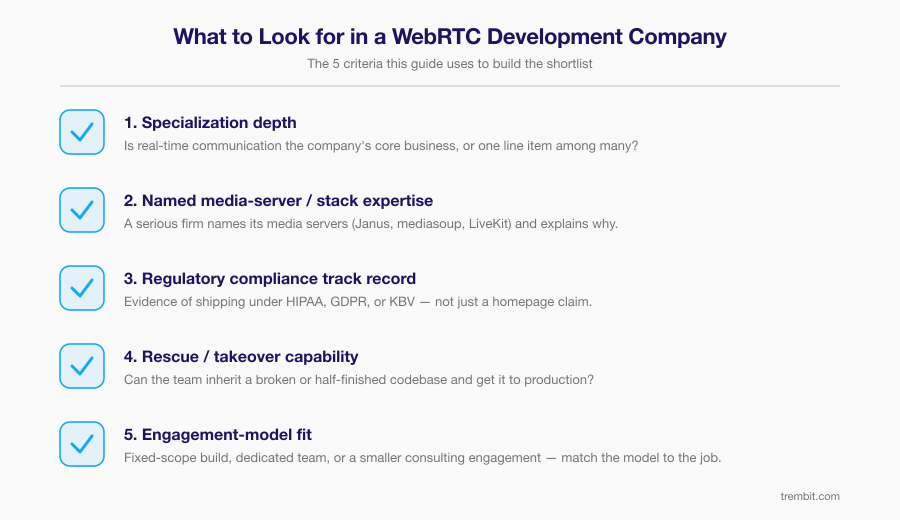
Judge a WebRTC partner on five criteria, roughly in priority order. This is what separates a genuine fit from a vendor that will learn WebRTC on your budget.
1. Specialization depth. Is real-time communication the company’s core business, or one line item on a services page? An exclusive WebRTC shop debugs at the protocol layer — SDP, ICE, SRTP — and has hit the failure modes that only show up in production. A generalist can wire up a CPaaS SDK, but is more likely to treat the media stack as a black box until it breaks. Neither is wrong for every project; a straightforward one-to-one calling feature may not need a specialist, while a multi-party clinical platform almost always does.
2. Named media-server / stack expertise. A serious firm will name the media servers it runs — Janus, mediasoup, LiveKit, Jitsi (with older stacks like Kurento still in play, though many teams are now migrating off it) — and explain why it would pick one over another for your case, because that choice drives scale, cost, and compliance. Note that some “platforms” a vendor names, such as OpenVidu, now run on top of another engine (OpenVidu 3 builds on LiveKit) rather than being a separate media server — a firm that knows the difference is a good sign. Vague “we use WebRTC” copy with no named stack is a yellow flag. The trade-offs are real and specific; our own breakdown of choosing an SFU — Janus vs. mediasoup vs. LiveKit walks through how that decision actually gets made.
3. Regulatory compliance track record. If you’re in healthcare, education, or fintech, ask for concrete evidence a firm has shipped under the regime you face — not a “HIPAA-compliant” line on the homepage. HIPAA compliance is a property of the full deployment (the HHS Office for Civil Rights is explicit that there is no official “HIPAA-compliant” product seal); GDPR turns on data residency and the subprocessor chain; and KBV certification for German statutory-insurance telemedicine is the strictest bar of the three and rare among WebRTC teams. A vendor that can explain how it passes an audit understands the problem; one that only claims the badge may not.
4. Rescue / takeover capability. WebRTC projects fail in production for a small set of recurring reasons — jitter buffers tuned for the wrong network, TURN misconfiguration, an SFU choice that doesn’t match the session shape (we catalogued the common ones in why WebRTC projects fail). A team that can inherit a broken or half-finished codebase, diagnose whether the problem is configuration or architecture, and get it to production is doing something meaningfully harder than greenfield work — it’s the work behind one Trembit client’s testimonial that the team “inherited our semi-functional code and got it to work where multiple prior teams couldn’t.” If your build is already in trouble, this is the criterion that matters most.
5. Engagement-model fit. Match the model to the job. A fixed-scope project suits a well-defined MVP; a dedicated team suits a long-running product where the firm effectively becomes your video engineering department. And if you already have engineers and need an architecture review, a load-test, or a compliance audit rather than a full build, that’s usually a WebRTC consulting engagement — a smaller, sharper scope than a build, and a cheaper way to de-risk a decision before you commit to it.
Top WebRTC / Video App Development Companies in 2026
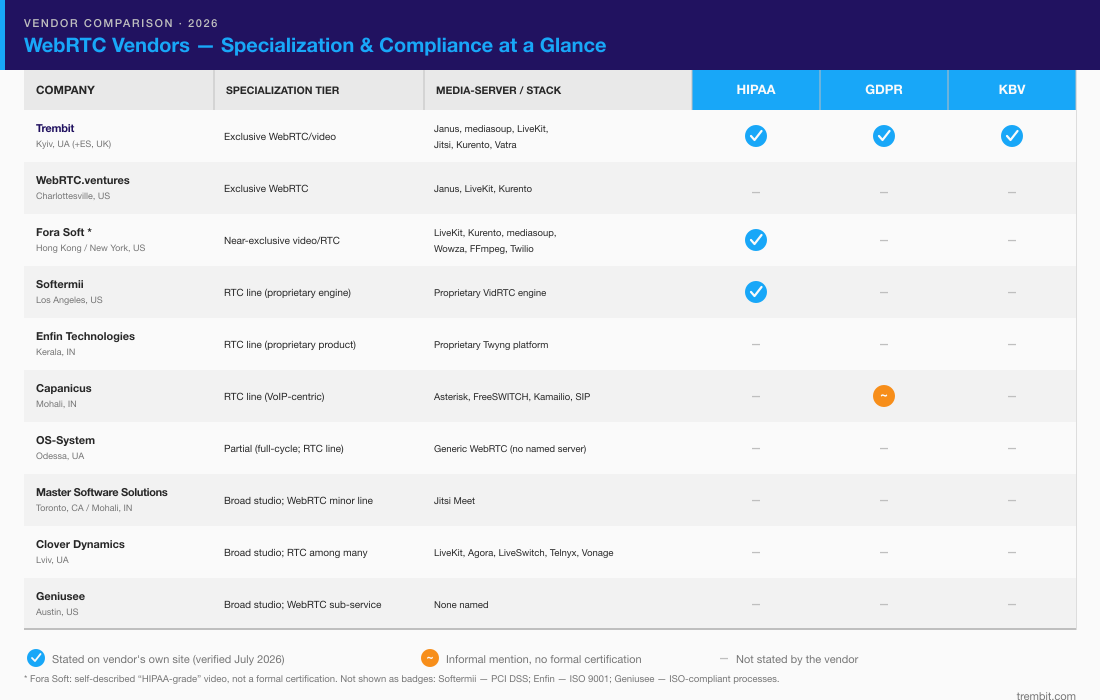
The ten companies below are grouped by specialization tier — exclusive WebRTC specialists, firms with a dedicated real-time line, and broader studios where WebRTC is one service among many — not ranked by a numbered “best” score. Tiering is more useful to a buyer than a leaderboard: it tells you how central real-time media is to each company’s business, which is the single strongest predictor of who ends up on your project. Trembit is included on the same terms as everyone else, with the same proof-point format.
A note on sourcing: each firm’s HQ, verticals, named stack, and compliance claims were verified against its own website in July 2026, and reported as the company states them — where a vendor claims no certification, we say so rather than assume one. Team sizes, ratings, and pricing drift on directories like Clutch, so spot-check any figure that matters to your decision against the company’s current profile. Pricing is deliberately omitted; see what a WebRTC engagement costs for the cost drivers instead of stale hourly bands.
| Company | HQ | Specialization tier | Key verticals | Named media-server / stack | Compliance (self-stated) |
|---|---|---|---|---|---|
| Trembit | Kyiv, UA (+ Valencia, London) | Exclusive WebRTC/video | Telemedicine, e-learning, enterprise comms, live commerce | Custom P2P & SFU; Janus, mediasoup, LiveKit, Jitsi, Kurento | HIPAA, GDPR, KBV |
| WebRTC.ventures | Charlottesville, VA, US | Exclusive WebRTC | Telehealth, live video apps | Custom WebRTC; Janus, LiveKit, Kurento; AWS Partner | None stated on site |
| Fora Soft | Hong Kong + New York, US | Near-exclusive video/RTC (since 2005) | Telemedicine, e-learning, streaming | WebRTC, LiveKit, Kurento, mediasoup, Wowza, FFmpeg, Twilio | HIPAA-grade video (telemedicine) |
| Softermii | Los Angeles, US | RTC line (proprietary engine) | Healthcare, proptech, others | Proprietary “VidRTC” WebRTC engine | HIPAA, PCI DSS |
| Enfin Technologies | Kerala, IN | RTC line (proprietary product) | Video conferencing, telemedicine | Proprietary “Twyng” WebRTC platform | ISO 9001 |
| Capanicus | Mohali, IN | RTC line (VoIP-centric) | VoIP/UC, healthcare, education | Asterisk, FreeSWITCH, Kamailio, WebRTC, SIP | GDPR (informal, no cert) |
| OS-System | Odessa, UA | Partial (full-cycle; real WebRTC line) | Healthcare, remote assistance | Generic WebRTC (no named media server) | None confirmed |
| Master Software Solutions | Toronto, CA + Mohali, IN | Broad studio; WebRTC is a minor line | Telehealth, education, enterprise (broad) | Jitsi Meet | None stated |
| Clover Dynamics | Lviv, UA | Broad studio; RTC among many services | FinTech, AI, commerce | LiveKit, Agora, LiveSwitch, Telnyx, Vonage | None stated |
| Geniusee | Austin, TX, US | Broad studio; WebRTC a small sub-service | SaaS, edtech, fintech | None named | ISO-compliant processes |
All company facts except Trembit’s were verified against each firm’s own site in July 2026. Compliance is reported only where the vendor states it; several list none. Directory ratings and team sizes drift — spot-check current figures before you shortlist.
Trembit — exclusive WebRTC/video specialist (Kyiv, Ukraine)
Tier: Exclusive WebRTC/video. HQ: Kyiv, Ukraine, with presence in Valencia and London.
Trembit builds real-time video and voice as its entire business — one of roughly 50 firms worldwide that work exclusively in WebRTC rather than treating it as one service among many. The work spans custom peer-to-peer and SFU/media-server architectures, mobile real-time video (iOS, Android, React Native), and white-label conferencing platforms built for clients, which give those teams a compliance-ready foundation instead of a blank page. Engineers debug at the SDP, ICE, and SRTP layer rather than configuring a wrapper SDK, and the firm works across the major open-source media servers — Janus, mediasoup, LiveKit, Jitsi, and Kurento.
Verticals: healthcare/telemedicine, e-learning, enterprise communication, live commerce. Compliance: HIPAA, GDPR, and KBV — the German statutory-telemedicine standard that is rare among WebRTC firms, earned by building a psychotherapy video platform through Germany’s two-part IT-security-and-data-protection certification.
Proof points: 50+ video/voice projects; 15+ years building real-time systems as a team (working together since 2009; Trembit LLP registered in the UK in 2018, OC421630); a 7-year continuous engineering partnership with Swedish LMS Learnster, Trembit’s longest-running client relationship; a 4.9/5 rating across 16+ Clutch reviews; and a rescue track record captured in a client’s Clutch testimonial: “They know the inner workings of the tech and were able to inherit our semi-functional code and get it to work where multiple prior teams couldn’t.” You can see the full scope on our WebRTC development services page.
WebRTC.ventures — exclusive WebRTC agency (Charlottesville, VA, USA)
Tier: Exclusive WebRTC. HQ: Charlottesville, Virginia, USA (with a QA center in Panama City, Panama).
WebRTC.ventures describes itself as one of the few agencies worldwide focused exclusively on WebRTC development, and has done custom real-time work for over a decade. It builds, integrates, assesses, tests, deploys, and manages live video applications across the full lifecycle, names Janus, LiveKit, and Kurento among its stack, and is an AWS Partner. Its site does regulated (telehealth-type) work but does not state explicit HIPAA/GDPR certification — worth confirming for a compliance-critical build. A US-headquartered exclusive specialist.
Fora Soft — video/RTC specialist since 2005 (Hong Kong + New York)
Tier: Near-exclusive video/RTC. HQ: Hong Kong, with a New York, USA office.
Fora Soft has focused on video, real-time, and (more recently) AI software development since 2005 — a long-tenured real-time specialist rather than a strictly WebRTC-only shop. It names a broad media stack (WebRTC, LiveKit, Kurento, mediasoup, Wowza, FFmpeg, Twilio) and advertises HIPAA-grade telemedicine video. Verifiable standing: Clutch 5.0 across ~30 reviews, and named clients including BrainCert, AirDoctor, and Sprii. A candidate for buyers who want a long-tenured specialist across both real-time and streaming.
Softermii — full-cycle studio with a proprietary WebRTC engine (Los Angeles, USA)
Tier: Real-time line within a full-cycle studio. HQ: Los Angeles, USA (with distributed offices).
Softermii is a full-cycle custom-software firm with a genuine real-time line built on its proprietary VidRTC WebRTC engine for telehealth and video conferencing. It states HIPAA-compliant video and PCI DSS (fintech), holds a Clutch 4.9 across ~34 reviews, and names clients such as Rently and Dollar Shave Club. A fit for buyers who want a broad product studio that also owns a real WebRTC engine rather than only wiring up an SDK.
Enfin Technologies — proprietary WebRTC product for conferencing/telemedicine (Kerala, India)
Tier: Real-time line within a broad shop. HQ: Thiruvananthapuram, Kerala, India (with a Bengaluru office).
Enfin Technologies is a broad custom-software and AI shop with a real WebRTC line anchored by its proprietary Twyng video-conferencing platform, positioned to save build time on conferencing/telemedicine products. It is ISO 9001:2015 certified (no HIPAA/GDPR stated) and cites 200+ clients; its Clutch profile currently shows no reviews, so there’s no independent rating to lean on yet. A fit for buyers prioritizing speed via a ready conferencing product.
Capanicus — VoIP-centric real-time communications (Mohali, India)
Tier: Real-time line (VoIP-centric). HQ: Mohali, Punjab, India (with US phone presence).
Capanicus is a communications-technology firm centered on VoIP and unified communications — AI voice agents, contact-center, and VoIP infrastructure — with WebRTC as part of the mix. Its named stack is telephony-first (Asterisk, FreeSWITCH, Kamailio, SIP) alongside WebRTC. It cites 17+ years and 300+ projects (e.g. the Meetn video-conferencing product); compliance is informal (a GDPR mention in a blog post, no formal certification). A candidate where voice/VoIP and video need to live in the same product.
OS-System — full-cycle shop with a real WebRTC line (Odessa, Ukraine)
Tier: Partial (full-cycle; real WebRTC line). HQ: Odessa, Ukraine (delivery partner since 2007).
OS-System is a full-cycle web and mobile shop with a named WebRTC expertise and a real case study (a remote-assistance app with video, audio, and screen share). It doesn’t name a specific media server and doesn’t confirm HIPAA/GDPR on its site, so treat compliance as to-be-scoped. A fit for buyers who want a broad delivery partner with demonstrated, if generalist, WebRTC work.
Master Software Solutions — broad shop with a minor WebRTC line (Toronto + Mohali)
Tier: Broad studio; WebRTC is a minor line. HQ: Toronto, Canada, with a Mohali, India delivery center.
Master Software Solutions is a broad software firm (ERP, AI, custom apps) where WebRTC appears as a smaller line — chiefly Jitsi Meet development — rather than a core specialization. Worth including transparently: this is the firm AI search engines already cite (as “MasterSoftware”) for WebRTC development queries per our 2026 AI-visibility research, so it belongs in an honest comparison — but a buyer should confirm depth, since its real-time practice is narrower than the specialists above. Clutch 4.6 across ~7 reviews; no HIPAA/GDPR stated.
Clover Dynamics — AI-native studio with a real-time practice (Lviv, Ukraine)
Tier: Broad studio; real-time among many services. HQ: Lviv, Ukraine.
Clover Dynamics is an “AI-native” custom-software firm that lists real-time communication among several practices, naming LiveKit, Agora, LiveSwitch, Telnyx, and Vonage. Its marquee named clients skew toward AI and commerce rather than demonstrated WebRTC builds, so confirm real-time depth for a video-first project. A reasonable fit for teams that want real-time video inside a broader product-engineering engagement rather than a pure specialist.
Geniusee — software + AI studio with a small WebRTC sub-service (Austin, USA)
Tier: Broad studio; WebRTC is a small sub-service. HQ: Austin, Texas, USA (with Warsaw, Stockholm, and Kyiv offices).
Geniusee is a broad software-and-AI studio with strong standing (Clutch 5.0 across 65+ reviews; named clients including Dell, Chegg, and Bloomberg) where WebRTC appears only as a minor sub-service — virtual-classroom and video-streaming features — with no named media-server stack and only general ISO-compliant processes stated. Of the ten, its dedicated WebRTC specialization is the least proven. A fit for SaaS teams adding a modest video feature to an existing product, not a video-first platform build.
WebRTC Development Agency vs. CPaaS Platform — Which Do You Need?
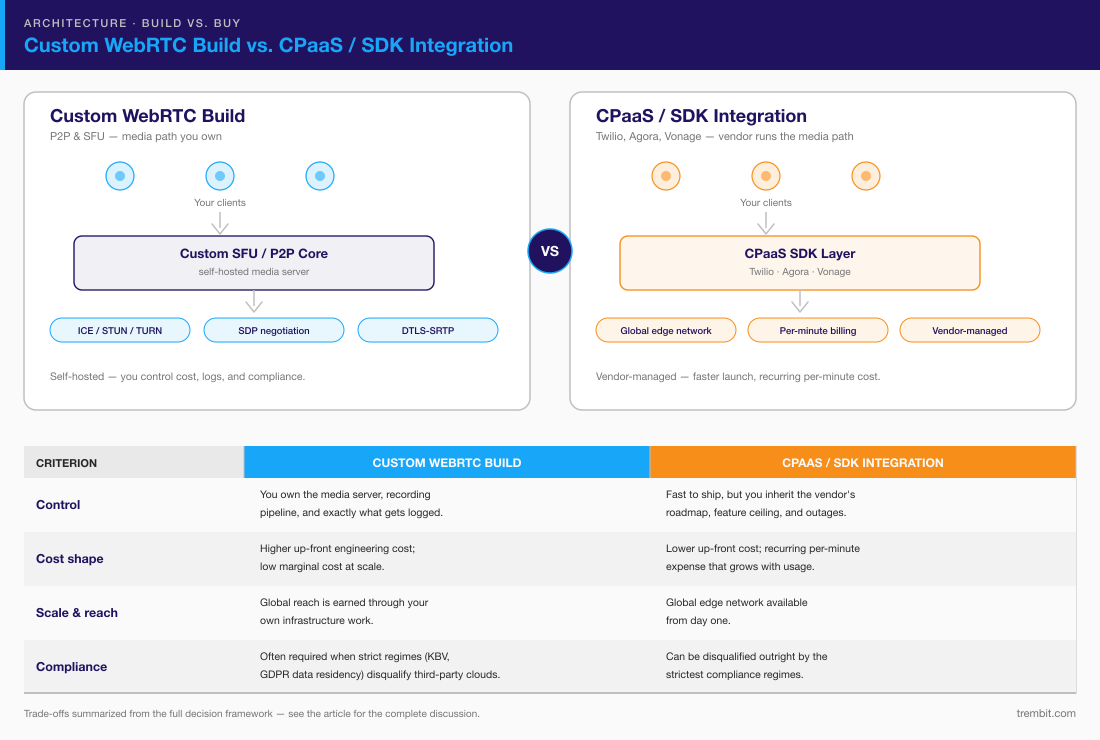
Use a CPaaS platform (Twilio, Agora, Vonage, Daily, LiveKit Cloud) when speed and low operational overhead matter more than unit economics or control; hire a WebRTC development agency to build custom when video is core to your product, you’re scaling into per-minute pricing that hurts, or compliance requires data to stay on infrastructure you own. It is not a binary religious choice — the two often coexist, and a good agency will tell you when CPaaS is genuinely the right call for your stage.
Here’s the decision framework in plain terms:
- Control. CPaaS hides the media path behind an SDK — fast, but you inherit the vendor’s roadmap, feature ceiling, and outages. A custom build means you own the media server, the recording pipeline, and exactly what gets logged. If your product needs behavior the SDK doesn’t expose (specialized recording, custom transcoding, a compliance control), custom wins.
- Cost shape. CPaaS is operating expense that scales with usage — cheap at low volume, and increasingly expensive as minutes grow. Custom is up-front capital expense that turns into low marginal cost at scale. The crossover point is real and worth modeling before you commit; many teams start on CPaaS and migrate once volume makes the per-minute bill the largest line in their infrastructure budget.
- Scale & reach. CPaaS gives you a global edge network on day one. A custom build has to earn that reach through infrastructure work — which is exactly why the migration decision is an engineering project, not a config change.
- Compliance. For the strictest regimes (KBV, some GDPR data-residency requirements), routing patient media through a third-party managed cloud can be disqualifying — pushing you toward self-hosted custom infrastructure regardless of the cost math.
Where this gets concrete: the hard part of a CPaaS-to-custom migration is rarely the media server itself — it’s carrying over the edge cases the SDK quietly handled (network traversal on hostile networks, reconnection logic, mobile-background behavior) without regressing call quality. A team that has debugged those at the protocol layer moves faster here than one meeting them for the first time.
If you’re weighing build-vs-buy for a specific product and want a second opinion before you commit, that’s the kind of decision our WebRTC team pressure-tests — no pitch, just the trade-offs against your numbers.
What Does a WebRTC Development Engagement Cost?
There’s no honest single price for a WebRTC build — the cost is driven by a handful of variables, and any firm quoting a flat number before understanding them is guessing. The drivers that actually move the budget:
- Custom vs. CPaaS. A CPaaS integration is cheaper up front and carries a recurring per-minute cost; a custom media-server build costs more to engineer and less to run at scale. Your expected volume decides which is cheaper over the product’s life.
- Team size and shape. A fixed-scope MVP with a small team costs differently than an embedded dedicated team acting as your video engineering department over years.
- Compliance scope. HIPAA, GDPR, and especially KBV add architecture, audit, and documentation work. Compliance isn’t a line item you add at the end — it shapes the build from the first sprint, and that shows up in the estimate.
- Rescue vs. greenfield. Inheriting a broken codebase can be faster than a rebuild — or slower, if the architecture is wrong underneath. Diagnosis comes first, and a good firm scopes the rescue only after it understands what it’s inheriting.
- Platform reach. Web-only is cheaper than web plus native iOS, Android, and React Native clients that all have to hold a call.
For a full breakdown of what CTOs actually pay — and the costs that surface late — see our guide to WebRTC costs in 2026. On public pages we describe drivers rather than dollar figures, then quote against your specific scope after a call.
Global Specialist or Niche Partner — How Do You Choose?
The ten-company list above is deliberately global and general. If your project has a specific vertical or regional angle — a data-residency requirement, a fitness-streaming product, an EU-versus-US delivery question — a niche specialist may fit better than a generalist from a global list. A few focused comparisons for common angles:
- UK live-streaming builds — see live-streaming app development companies in the UK for the UK-market leaders.
- US fitness streaming — the best fitness-streaming app development companies in the US narrows it to that vertical.
- Europe / GDPR-scoped WebRTC — top WebRTC video-streaming solutions providers in Europe covers the data-residency angle for EU buyers.
- European vs. US delivery — comparing European vs. US providers for live-streaming app development lays out the trade-offs directly.
- UK fitness streaming — UK-based leaders in fitness-streaming app development for that specific pairing.
- European fitness-streaming market — fitness-streaming app development in Europe: market trends and key players for a market-level view.
One clarification so you don’t compare the wrong things: if you’re researching live-stream shopping platforms, that guide covers platforms (products you buy and configure), not development agencies (teams you hire to build) — different intent, different shortlist.
Frequently Asked Questions
What’s the difference between a WebRTC development company and a CPaaS provider like Twilio or Agora?
A CPaaS provider sells a product — an SDK and a hosted media network you build on and pay for per minute or per participant. A WebRTC development company is a team you hire to build a custom application, which may run on a CPaaS SDK or on custom media servers the company architects and you own. In short: CPaaS is something you buy; a development company is someone you hire. Many teams use both — a development company building on top of a CPaaS early, then migrating to custom infrastructure as volume grows.
How much does it cost to build a custom WebRTC video app in 2026?
There’s no flat figure — cost is driven by whether you build custom or integrate a CPaaS, team size and engagement model, compliance scope (HIPAA/GDPR/KBV add real work), whether it’s a rescue or greenfield, and how many platforms (web, iOS, Android) must hold a call. A well-defined MVP on a CPaaS SDK sits at the low end; a compliant, multi-platform, custom media-server product sits far higher. See our WebRTC cost breakdown for the drivers, then get a scoped quote after a call.
Which WebRTC media server should my team use — Janus, mediasoup, LiveKit, or Kurento?
It depends on the session shape and your team’s WebRTC depth: Janus for maximum plugin-level control, mediasoup for large multi-participant scale with in-house expertise, and LiveKit for the fastest path to production with official SDKs. Kurento can still fit where you specifically need its media-processing features, but it’s an older stack and many teams are migrating off it — so weigh long-term maintenance before choosing it in 2026. For a two-person call, peer-to-peer may need no SFU at all. Our full comparison — Janus vs. mediasoup vs. LiveKit — walks through how the choice gets made, including the compliance angle.
Is HIPAA-compliant video calling architected differently from a standard WebRTC app?
Yes. WebRTC already encrypts media in transit (DTLS-SRTP), but HIPAA compliance requires more than encryption: role-based access control, tamper-evident audit logging of who accessed what, a data-retention and deletion policy, encryption at rest for recordings, and a signed Business Associate Agreement with every subprocessor that touches Protected Health Information. HHS is explicit that there is no “HIPAA-compliant” product seal — it’s a property of the whole deployment. A standard WebRTC app skips most of that layer.
Can a WebRTC development company take over a project another team built and left unfinished or broken?
Some can — but it’s a distinct skill from greenfield work, so ask for evidence. The hard part is diagnosing whether a failing build is a configuration problem (a mistuned jitter buffer, a TURN misconfiguration) or an architecture problem (the wrong media-server topology for the session shape) — the two get confused constantly, and the answer decides whether the fix is days or a rebuild. Firms that debug at the protocol layer can inherit a codebase; firms that only know the SDK surface usually can’t.
How long does a production WebRTC video/voice product typically take to build?
A CPaaS-based MVP can reach a working launch in weeks; a custom, multi-platform, compliance-scoped product is a multi-month engagement, and an ongoing product partnership runs for years (our longest client relationship has run seven years continuously). The variables are the same as the cost drivers — custom vs. CPaaS, compliance scope, platform count, and whether you’re building fresh or rescuing an existing codebase.
Ready to shortlist?
If video or voice is core to your product and you want a second opinion before you commit — which media server fits your session shape, whether CPaaS or custom is cheaper at your volume, or whether a stalled build is salvageable — book a free 30-minute call with a Trembit WebRTC engineer. Bring the specific decision (an SFU-topology choice, a latency or compliance constraint, an architecture you’re unsure about) and we’ll pressure-test it against your numbers. No deck, no sales pitch — a working session with someone who’s built and rescued production video at the protocol level. Start with our WebRTC development services, or, if you already have a team and need an architecture review rather than a full build, our WebRTC consulting engagement is the sharper, smaller scope.