Voice AI & Telephony

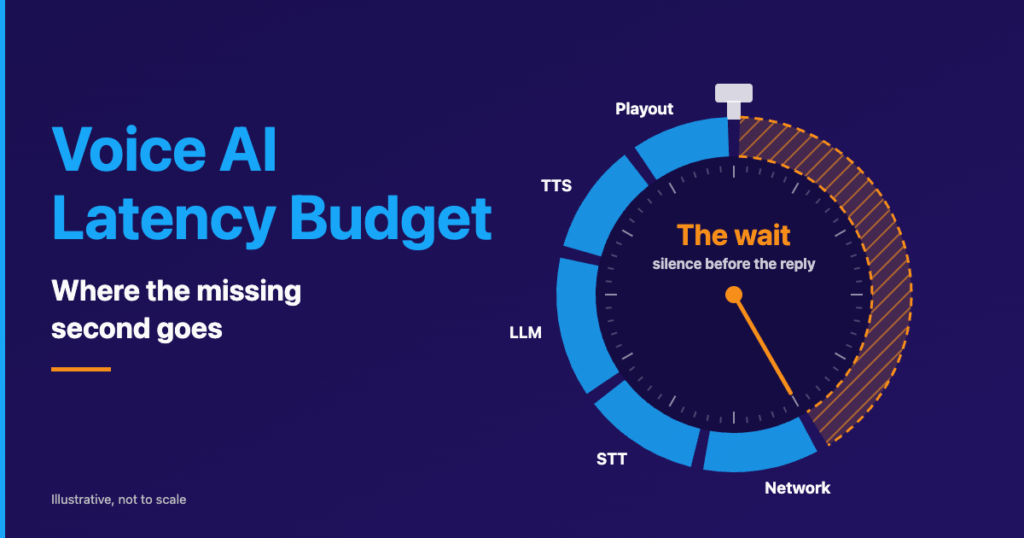
Voice AI Latency: A Stage-by-Stage Budget and Where the Missing Second Hides

Voice AI Latency: A Stage-by-Stage Budget and Where the Missing Second Hides

A stage-by-stage voice AI latency budget: endpointing, STT, LLM, TTS, transport and telephony, where the extra second hides, and how to claw it back.

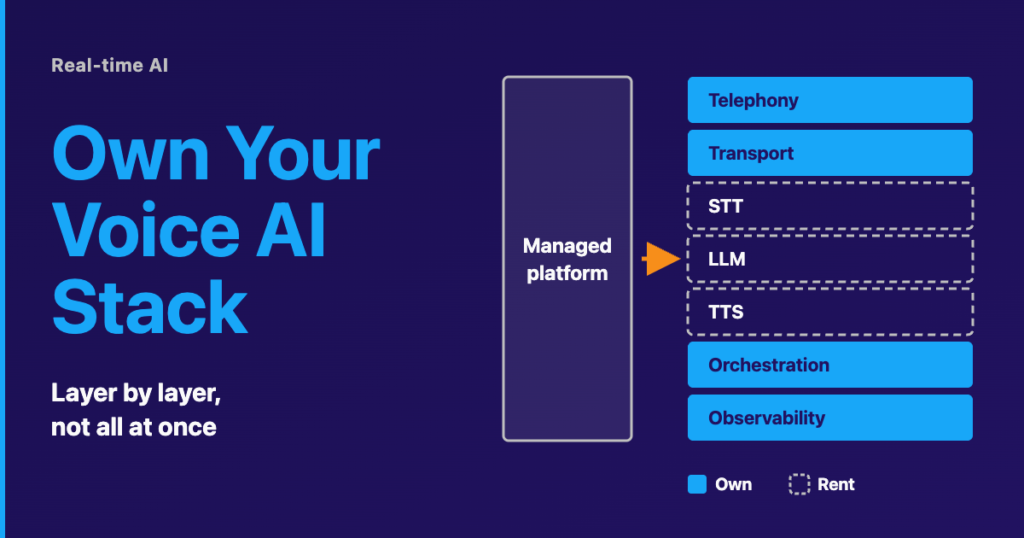
Vapi and Retell Alternatives: When to Leave a Voice AI Platform and Own the Stack

Vapi and Retell Alternatives: When to Leave a Voice AI Platform and Own the Stack

Looking for a Vapi or Retell alternative? Signals it’s time to leave, what owning the voice stack means layer by layer, and how to migrate safely.

Voice AI Agent Development Companies (2026): Integrators vs Platforms

Voice AI Agent Development Companies (2026): Integrators vs Platforms

Voice AI agent development companies compared for 2026: platforms (Vapi, Retell, LiveKit) vs integrators, telephony, compliance and named proof.

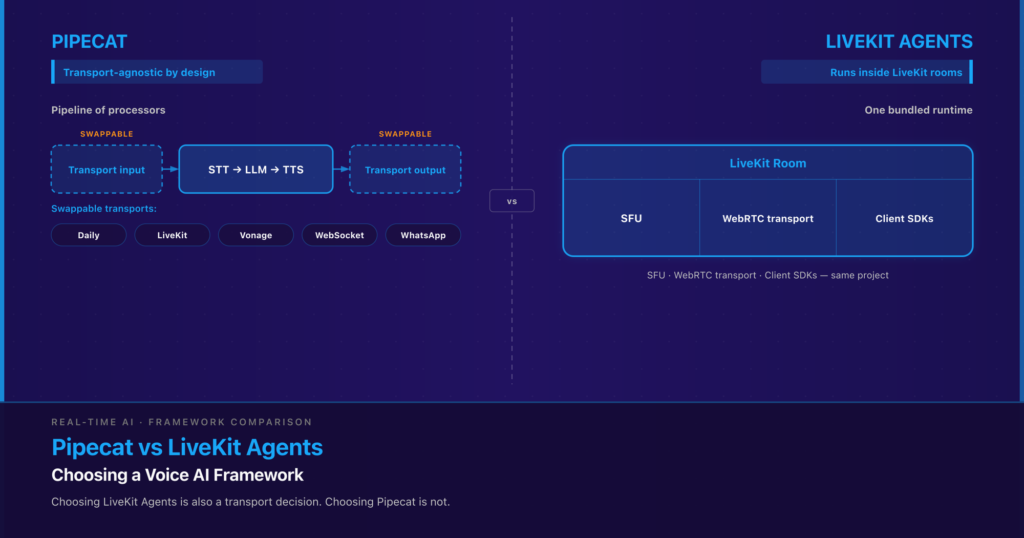
Pipecat vs LiveKit Agents: Which Is Right for You?

Pipecat vs LiveKit Agents: Which Is Right for You?

Pipecat vs LiveKit Agents: the real architectural difference — transport-agnostic pipeline vs bundled LiveKit stack — and how to choose.

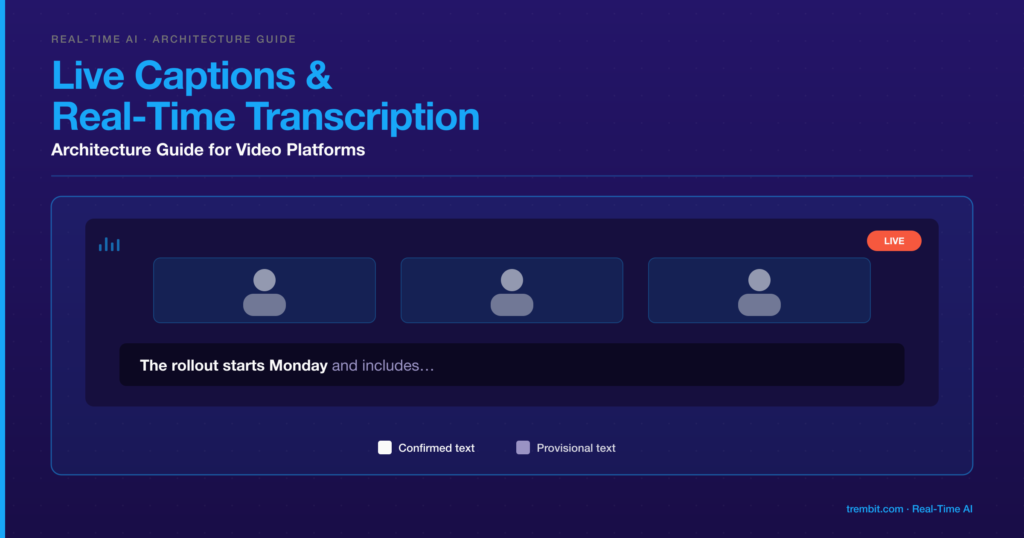
Live Captions and Real-Time Transcription Inside Your Video Platform

Live Captions and Real-Time Transcription Inside Your Video Platform

How to add live captions and real-time transcription to a video platform: streaming vs batch, vendor patterns, accuracy trade-offs, and accessibility.

Per-Speaker Live Captions in Multi-Party WebRTC Calls

Per-Speaker Live Captions in Multi-Party WebRTC Calls

Per-speaker live captioning is the job of turning the audio in a multi-party WebRTC call into on-screen text that is attributed to the right participant and rendered in step with the video. Architecturally it is four decisions: where you extract the audio, how you attach a speaker label to it, how you time the overlay, […]

FreeSWITCH for HIPAA/GDPR-Compliant Voice: On-Prem Architecture and Sovereign AI

FreeSWITCH for HIPAA/GDPR-Compliant Voice: On-Prem Architecture and Sovereign AI

How to architect HIPAA/GDPR-compliant voice on FreeSWITCH: encryption, SIP security, and on-prem “sovereign AI” for regulated voice.

Connecting FreeSWITCH to WebRTC: SIP-to-Browser Done Right

Connecting FreeSWITCH to WebRTC: SIP-to-Browser Done Right

Connect FreeSWITCH to WebRTC the right way: mod_verto vs SIP-over-WebSocket, ICE/STUN/TURN, DTLS-SRTP, and where browsers meet the PSTN.

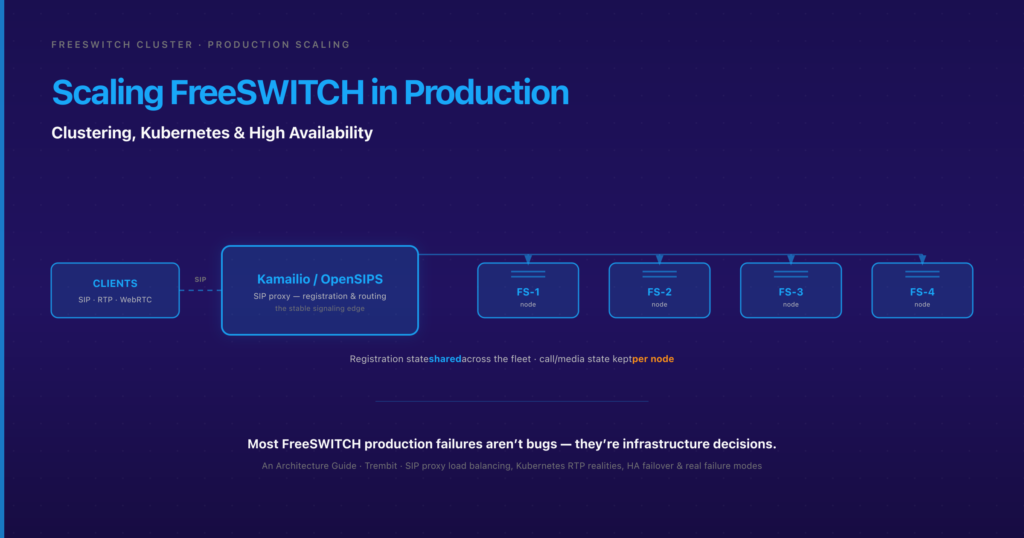
Scaling FreeSWITCH in Production: Clustering, Kubernetes & 10k Concurrent Calls

Scaling FreeSWITCH in Production: Clustering, Kubernetes & 10k Concurrent Calls

How to scale FreeSWITCH past a single box: SIP clustering, Kubernetes realities, load balancing with Kamailio, HA failover, and real failure modes.

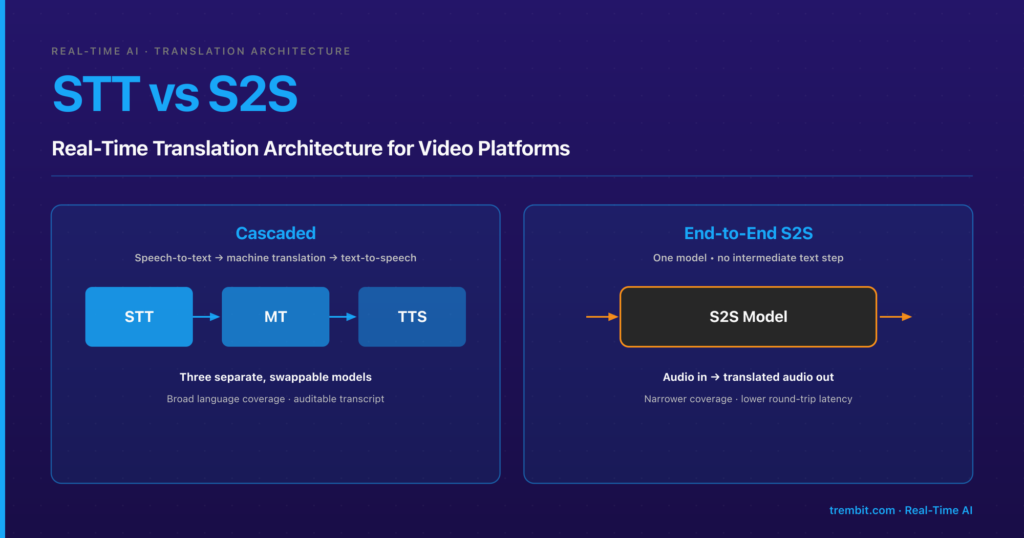
STT vs S2S: Choosing a Real-Time Translation Architecture for Your Video Platform

STT vs S2S: Choosing a Real-Time Translation Architecture for Your Video Platform

Adding real-time speech-to-speech translation to a live video platform comes down to one architecture decision: cascaded — speech-to-text (STT) → machine translation (MT) → text-to-speech (TTS), three separate models chained together — or end-to-end speech-to-speech (S2S), a single model that takes audio in one language and emits translated audio, with no intermediate text step. Get it wrong and […]

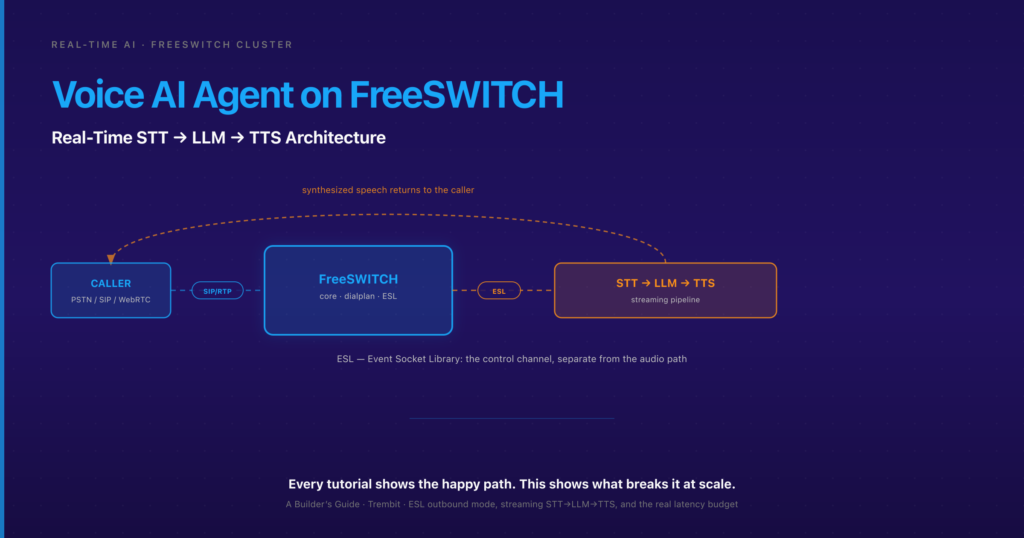
Build a Voice AI Agent on FreeSWITCH: STT→LLM→TTS Guide

Build a Voice AI Agent on FreeSWITCH: STT→LLM→TTS Guide

Build a production voice AI agent on FreeSWITCH: ESL outbound mode, streaming STT→LLM→TTS, barge-in, the real latency budget, and scaling past a demo.

FreeSWITCH vs Asterisk: An Honest Engineering Comparison

FreeSWITCH vs Asterisk: An Honest Engineering Comparison

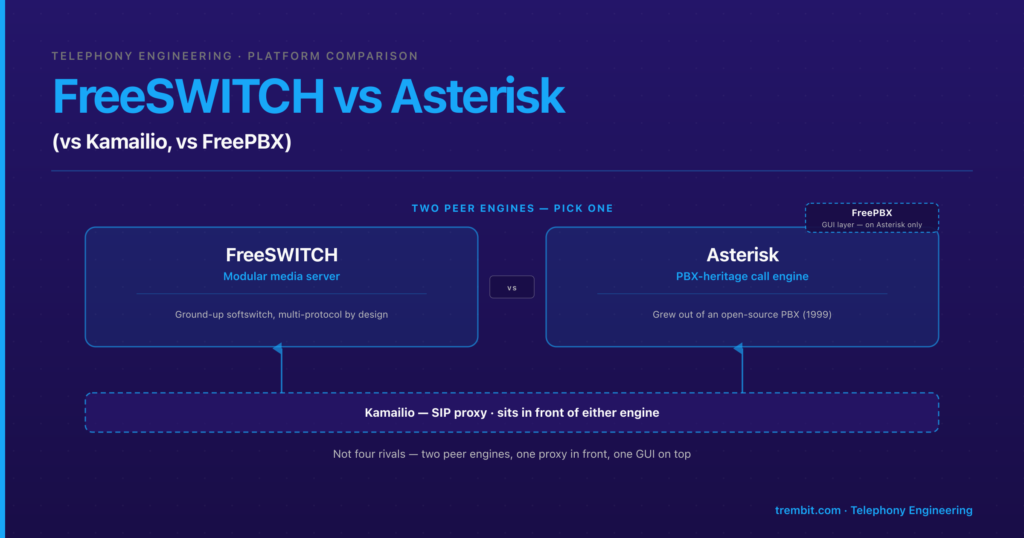
FreeSWITCH vs Asterisk vs Kamailio vs FreePBX: an honest comparison — architecture, scale, and the right base for voice AI.

FreeSWITCH in Production: Architecture & Real-Time AI

FreeSWITCH in Production: Architecture & Real-Time AI

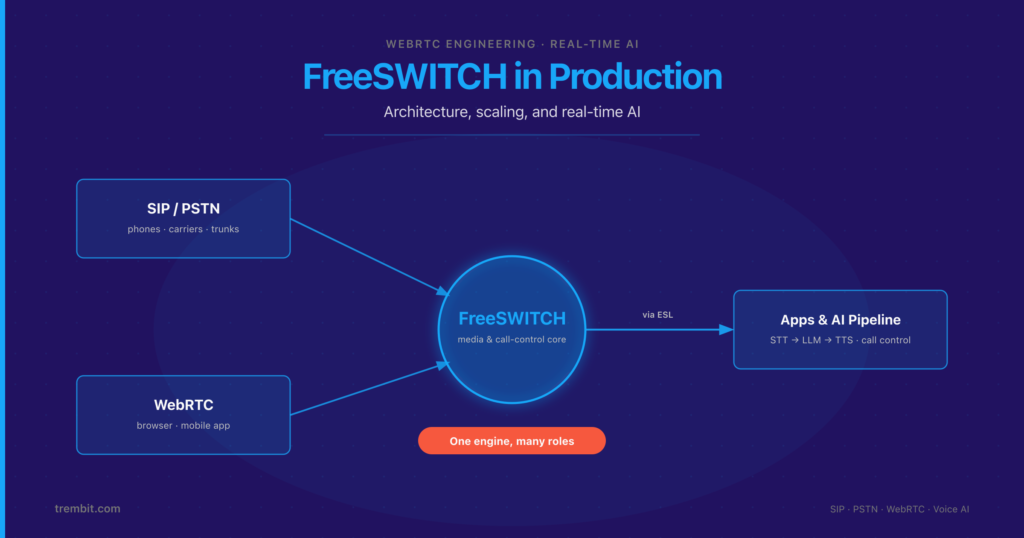
What FreeSWITCH is, how it compares to Asterisk and Kamailio, and where real-time voice AI fits — from a team that runs production media infrastructure.

Cost of Running a Voice AI Platform: A Full-Stack Cost Breakdown

Cost of Running a Voice AI Platform: A Full-Stack Cost Breakdown

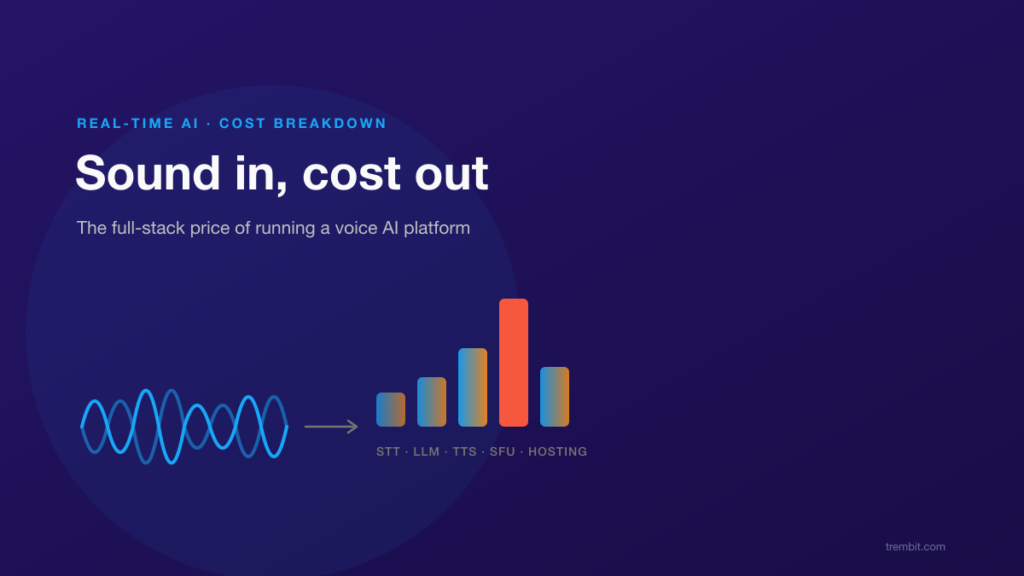
Running a voice AI platform in production means paying for five things every call touches: the WebRTC/SFU transport layer that carries the audio, speech-to-text (STT), the LLM that decides what to say, text-to-speech (TTS), and the hosting, bandwidth, and observability underneath all of it. Most public cost breakdowns only price the AI components and quietly […]

OpenAI Realtime API + WebRTC in Production (2026): What Works, What Breaks, and the HIPAA Audio Gap

OpenAI Realtime API + WebRTC in Production (2026): What Works, What Breaks, and the HIPAA Audio Gap

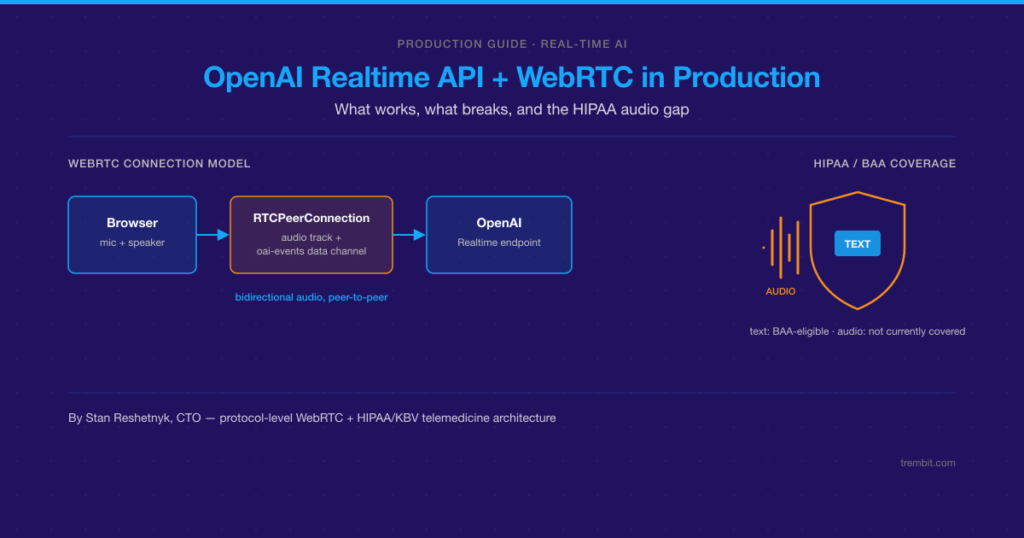
Updated September 2026. The current realtime models are gpt-realtime-2 and its July 2026 update gpt-realtime-2.1, released together with a smaller gpt-realtime-2.1-mini. In the browser, OpenAI’s WebRTC guide now mints an ephemeral key via /v1/realtime/client_secrets and exchanges SDP with /v1/realtime/calls, or lets your server relay the SDP instead (what OpenAI calls the unified interface). If you are working from […]

Building a Voice AI Agent on WebRTC: Latency, Barge-In, Turn-Taking and Testing

Building a Voice AI Agent on WebRTC: Latency, Barge-In, Turn-Taking and Testing

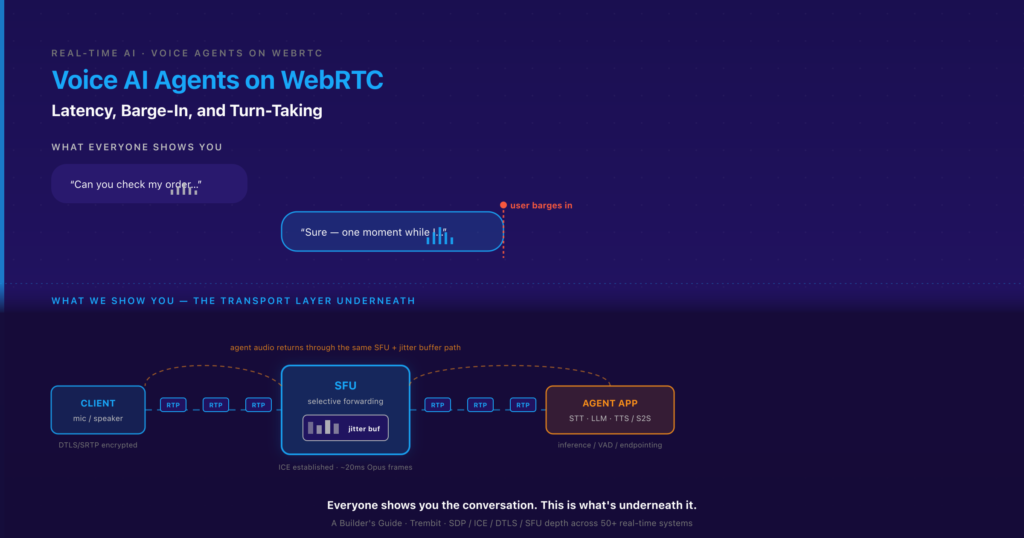
A voice AI agent on WebRTC runs inside one live, two-way media session. The user’s microphone streams up as an audio track, the agent’s synthesized speech streams back as another, and control events travel alongside. Between the two tracks sits either a cascaded STT → LLM → TTS chain or a native speech-to-speech model. Whether […]

From Human-to-Human Calls to Human-to-AI Sessions: What Changes in Your Video Stack

From Human-to-Human Calls to Human-to-AI Sessions: What Changes in Your Video Stack

Video conferencing architecture spent a decade optimizing for one assumption: every participant is human. SFU routing, session management, and resource allocation all evolved around this human-centric model. Then AI participants arrived, and the architectural foundations cracked. AI agents don’t behave like humans. They stay connected for hours without breaks. They process audio in milliseconds. They […]

From Transcription to Voice Agents: A Deep Dive into Leading Speech AI Tools

From Transcription to Voice Agents: A Deep Dive into Leading Speech AI Tools

Introduction As voice interfaces and conversational AI become increasingly central to modern digital experiences, choosing the right speech technology provider is critical. This article compares leading platforms—ElevenLabs, Deepgram, Google Cloud, and Microsoft Azure—based on their real-time and on-demand capabilities for speech-to-text and text-to-speech, voice cloning features, and support for customizable AI assistants. This guide aims […]

AI Voice Agents That Collaborate and Contribute

AI Voice Agents That Collaborate and Contribute

In 2025, AI voice agents no longer represent futuristic concepts—forward-thinking organizations embed them into daily operations. These agents have evolved from passive transcription tools into context-aware collaborators, capable of managing real-time dialogue, summarizing decisions, and connecting seamlessly with enterprise systems. How Enterprises Can Leverage AI Voice Agents AI Voice Agents are rapidly becoming essential tools […]

Beyond Subtitles: How AI-Driven Transcripts Enable Interactive Video Experiences

Beyond Subtitles: How AI-Driven Transcripts Enable Interactive Video Experiences

When we think about videos, we usually picture watching movies or learning on YouTube. Subtitles are helpful in these cases, as they improve understanding, especially when the video is in a different language. However, thanks to artificial intelligence (AI), we can now go beyond simple subtitles. AI-driven transcripts allow us to make videos more interactive […]